
Most conversations about humanity’s future fragment into silos. Biology, spirituality, ethics, technology, and space exploration develop in parallel, rarely intersecting. But futures do not emerge from fragments. They emerge from coherence.
Planetary Braid Theory is not a claim about objective reality. It is a symbolic model—a way to think about continuity, grounding, and what it might actually mean for humans to leave Earth without losing what makes us human.
It asks a simple but destabilizing question:
What if the human experience is not fully portable?
The Two Continuities That Form a Human Life
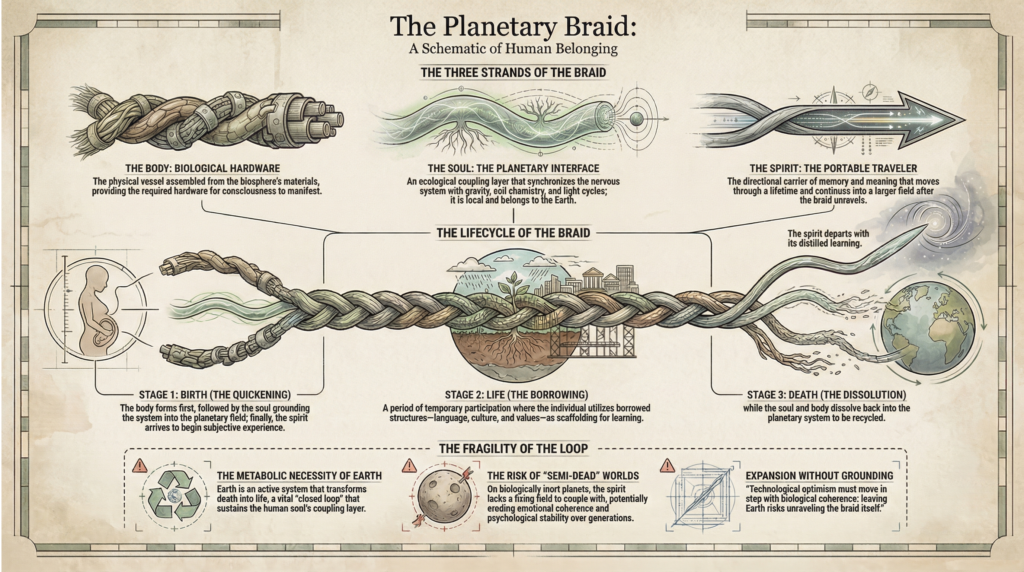
In this model, a human life arises from the temporary interweaving of two distinct continuities.
The soul functions as a planetary interface.
It is not belief, identity, or personality. It is the biological and rhythmic coupling that synchronizes a nervous system with a living world. Emotional regulation, instinctive intelligence, circadian timing, embodied intuition, and felt presence emerge from this coupling. The soul is ecological. It is local. It is grounded in a specific planetary field.
The spirit is the traveler.
It carries continuity of identity, memory, and meaning. Unlike the soul, it is not anchored to geography or environment. It moves through a lifetime, gathering experience, and then continues beyond it.
A human being, in this framing, is not a single strand. It is a temporary braid: a spirit inhabiting a body that is anchored to Earth through a soul. Neither strand alone constitutes a human life. Coherence emerges only where they interlace.
Borrowed Structures, Not Permanent Possessions
This model reframes the milestones of existence.
Birth begins materially. A body assembles first—cells, systems, neural scaffolding—forming a structure capable of hosting experience. The soul couples through environment and ecology, grounding that structure in planetary rhythms. Only then, in this model, does the spirit arrive: the point at which the system can support awareness.
Across life, we accumulate layers—language, values, skills, roles, relationships, identity. These feel like possessions, but they function more like borrowed frameworks. They enable experience, yet none are held permanently.
At death, the braid separates.
The spirit departs with distilled learning and integrated meaning. The soul releases its grounding function and dissolves back into the planetary system. The body returns its material to ecological circulation.
Life, in this sense, is not something we own. It is something we participate in for a while.
The Fragility of Continuity on Semi-Dead Worlds
This circulation depends on a living planet.
A biologically active world metabolizes death into transformation. It supplies the rhythmic, ecological field required for souls to ground and dissolve coherently.
On worlds without ecological vitality, this loop weakens. Technology may sustain bodies. Artificial environments may simulate conditions. But without a living planetary system, the soul—defined here as the interface between biology and environment—has no stable field to couple with.
Over generations, this absence may not end humanity outright. Instead, it may erode something subtler: grounding, psychological coherence, instinctive meaning.
Space migration, then, is not only an engineering challenge. It is an existential one.
The question shifts from “Can we survive elsewhere?” to “Which parts of us are fundamentally planetary?”
A Different Orientation Toward the Future
Taken symbolically, Planetary Braid Theory shifts posture rather than policy.
It favors stewardship over extraction, recognizing that humans are embedded in systems they must eventually return to. It reframes environmental protection as preserving the integrity of a coupling process between biology, consciousness, and place. It introduces restraint into technological ambition, suggesting that expansion without coherence carries hidden costs.
Some frameworks are not meant to be proven. They are meant to shape perception.
They influence how we notice risk, how we design futures, and how carefully we treat the living systems that quietly make experience possible. If humanity is a braid rather than a machine, then the central challenge is not reaching new worlds—but understanding what must remain intact when we do.

