
Customers don’t stay because they like you. They stay because leaving would cost them something they can’t afford to lose. Dependency Moats are created when you deliver a form of value that becomes embedded in how people operate, think, or succeed—something no alternative can replicate without friction, loss, or risk. When your work becomes essential infrastructure rather than optional input, loyalty stops being emotional and starts being structural.
Most Value Is Appreciated—Not Needed
Many products and services aim to be “better,” “faster,” or “cheaper.” That earns attention, maybe even preference—but not dependency. Appreciated value is easy to replace because it lives at the surface: features, pricing, aesthetics. Customers may enjoy it, but their identity, workflow, or outcomes aren’t bound to it. The moment a comparable option appears, switching becomes painless.
The problem isn’t competition. It’s substitutability.
Dependency Moats and Irreplaceable Value
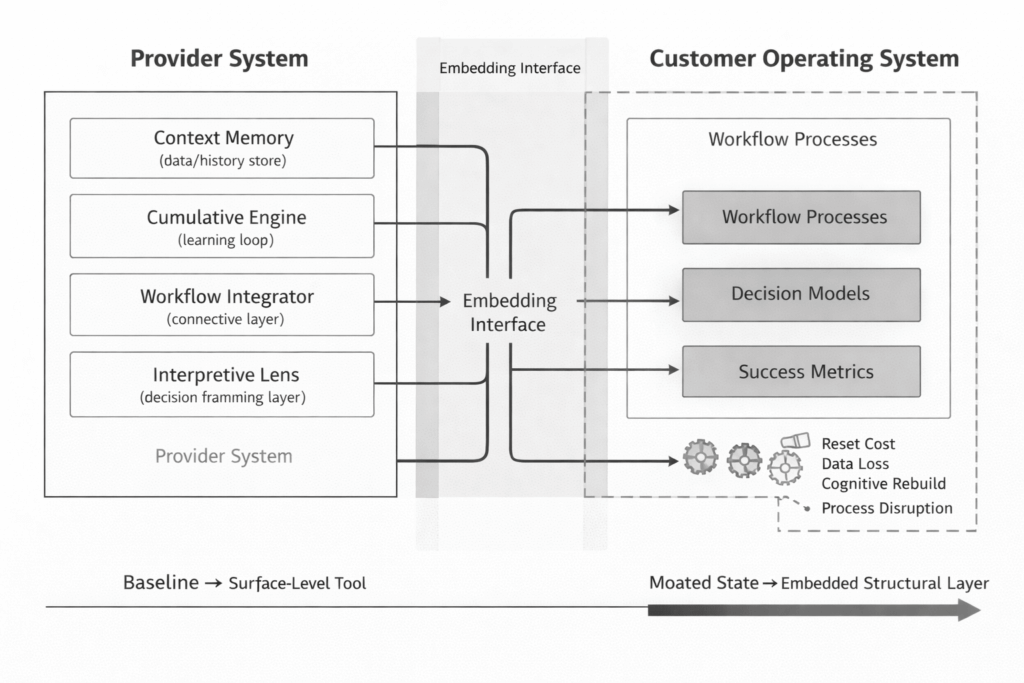
A Dependency Moat forms when your offering becomes tightly coupled to the customer’s success. Not as a tool they use—but as a capability they rely on. This happens when you deliver something that is:
-
Context-specific: Shaped by the customer’s data, history, or behavior.
-
Cumulatively valuable: Gets better the longer it’s used, making reset costly.
-
Integrative: Connects multiple parts of their workflow or thinking into one system.
-
Identity-linked: Influences how they make decisions or define success.
At this point, replacing you isn’t just a purchase decision—it’s a rebuild.
Designing Value That Customers Can’t Remove
To create a Dependency Moat, stop asking “What can we offer?” and start asking “What would break if we disappeared?”
Design around these principles:
-
Embed, don’t bolt on
Become part of the customer’s operating system. Insights, templates, dashboards, or frameworks that shape daily decisions create reliance through repetition. -
Accumulate advantage over time
Build systems that remember—preferences, patterns, benchmarks, progress. The longer someone stays, the more valuable staying becomes. -
Create asymmetric loss
Make leaving feel heavier than staying. Not through lock-in tactics, but through the loss of continuity, clarity, or momentum. -
Own a unique layer of meaning
Don’t just provide information—provide interpretation. When customers rely on your lens to understand their world, substitutes feel blind.
When Customers Can’t Do Without You
True customer retention isn’t about persuasion—it’s about necessity. When you give people something they can’t replicate elsewhere, and that they can’t remove without disrupting their success, loyalty becomes automatic. You’re no longer chosen; you’re assumed.
Dependency Moats don’t trap customers. They support them. And when you become the structure they build on, you stop competing for attention—and start occupying a permanent place in their system.