
Sales outcomes are often discussed as the result of effort, persuasion, or market timing. Yet when organizations experience sudden increases—or plateaus—in sales, the underlying cause is frequently structural rather than behavioral.
A useful place to start is with capacity. Any organization operates with a finite amount of cognitive, technical, and temporal capacity. How that capacity is allocated determines what kinds of results are even possible. When sales stall, it is often not because people are insufficiently motivated, but because attention and skill are consumed by work that does not directly support growth.
Outsourcing alters this allocation.
Consider a small technology firm facing rising demand. Orders increase, customer inquiries multiply, and product expectations escalate. Internally, the same limited team is responsible for maintaining infrastructure, responding to customers, fixing defects, and imagining what comes next. Even if everyone works harder, the system becomes congested. Growth pressure accumulates at the same nodes.
Outsourcing does not remove demand. It redistributes load.
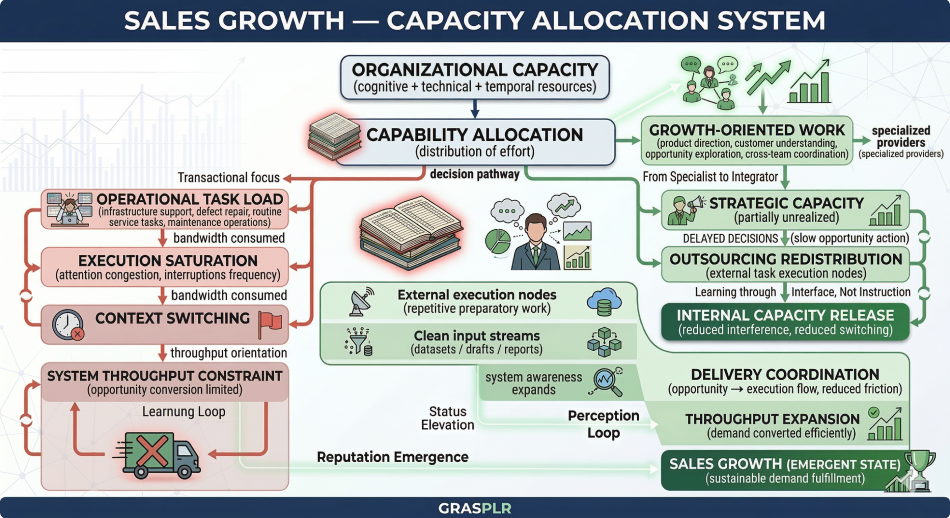
Capacity as a Limiting Structure
In systems terms, sales growth is constrained by throughput, not ambition. Throughput depends on how quickly an organization can move from opportunity to delivery without degradation in quality.

When employees are required to handle highly specialized or repetitive tasks alongside strategic work, the system couples dissimilar activities tightly together. Interruptions increase. Context-switching multiplies. Decision quality declines under time pressure.
Outsourcing selectively loosens this coupling. Tasks that are well-defined and repeatable can be handled externally, allowing internal capacity to reorganize around higher-variance work: product direction, customer understanding, and coordination across functions.
The immediate effect is not creativity or innovation. It is reduced interference.
Sales growth follows because fewer internal decisions are delayed or compromised by overload.
Access Without Accumulation
One structural advantage of outsourcing is access without accumulation. Hiring permanently increases fixed costs and organizational inertia. Outsourcing allows temporary or variable access to skills, tools, and infrastructure without permanently reshaping the organization.
This matters for sales because markets change faster than internal structures. When new customer needs emerge, organizations that rely only on internal capability must either stretch existing roles or pause to rebuild capacity. Both introduce lag.
Outsourcing shortens this lag by allowing organizations to respond to demand before fully internalizing it. The system remains lighter, more reversible. Sales teams are supported by operational elasticity rather than locked into yesterday’s capacity assumptions.
The metaphor of cultivation can be helpful here, if treated carefully. Growth does not come from forcing output, but from maintaining conditions that allow output to increase without collapse. Outsourcing functions like irrigation channels rather than fertilizer: it ensures flow where pressure would otherwise accumulate.
From Task Completion to Opportunity Detection
When internal teams are freed from operational saturation, a secondary effect appears. They begin to notice opportunities that were previously invisible.
This is not because they become more visionary, but because their attention is no longer monopolized by maintenance work. Sales insights often emerge from subtle patterns: repeated customer questions, friction points in onboarding, or unmet needs adjacent to existing products. These signals are weak and easy to miss when teams are overloaded.
Outsourcing creates slack, and slack increases sensitivity.
Over time, this sensitivity feeds back into product development, pricing, and positioning. Sales increase not through louder messaging, but through tighter alignment between what is offered and what is actually needed.
Sales as an Emergent Property
From this perspective, sales are not a lever to be pulled, but an outcome that emerges when capacity, attention, and coordination are aligned.
Outsourcing contributes by reshaping internal focus rather than by directly generating revenue. It allows employees to work at the level of abstraction where their judgment matters most. It reduces bottlenecks that quietly cap growth. It makes the organization more responsive without making it more fragile.
The important distinction is that outsourcing does not cause sales. It changes the system in which sales occur.
When growth follows, it is because the organization has become better at converting demand into delivery without exhausting itself in the process.