

Call us toll free: +64 226953063

Instant worldwide digital delivery — no waiting

GRASPLR Help & Support

Cost Reduction as a Reconfiguration of Fixed Commitments

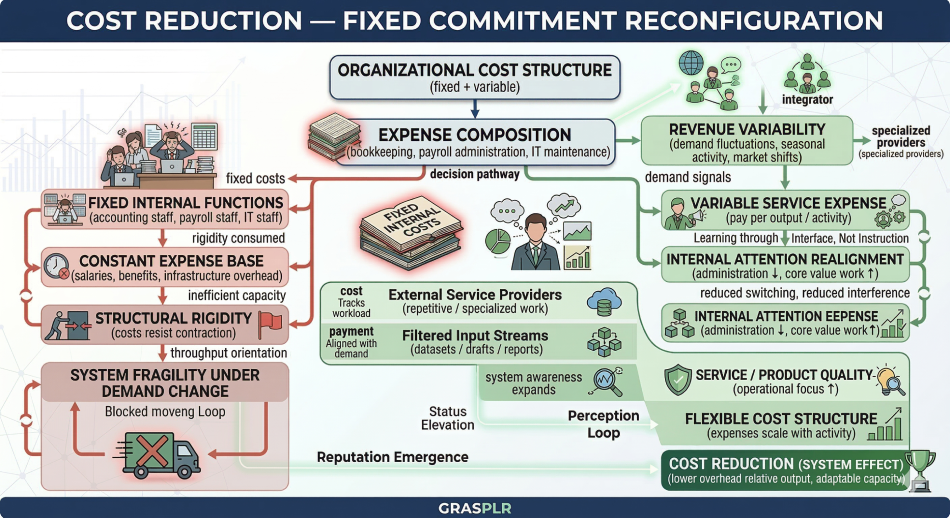
Cost reduction is often framed as a matter of restraint: spending less, cutting back, tightening control. Yet when organizations successfully reduce costs without degrading performance, the change usually comes from reconfiguration rather than reduction.

A familiar example is a small restaurant facing competitive pressure. Margins are thin, demand fluctuates, and many expenses are fixed regardless of how busy the dining room is. Bookkeeping and accounting must be done whether revenue is high or low, but hiring a full-time specialist permanently adds salary, benefits, software licenses, and workspace to the cost base.

Outsourcing shifts this structure.

Instead of carrying accounting as a fixed internal function, the restaurant converts it into a variable service. Costs begin to track actual activity rather than anticipated need. This adjustment alone alters the financial dynamics of the system.
Fixed Costs as Structural Rigidity

In systems terms, fixed costs increase rigidity. They reduce an organization’s ability to adapt to variation in demand because expenses remain constant even when revenue does not.

When too many internal functions are fixed, the organization becomes brittle. Small downturns create disproportionate stress. Management attention is pulled toward short-term survival rather than long-term coherence.

Outsourcing reduces this rigidity by decoupling certain functions from permanent internal structure. Bookkeeping, payroll, IT maintenance, and similar activities often have predictable interfaces and do not require continuous on-site presence. Treating them as external services allows costs to expand and contract with actual use.

The key point is not savings in isolation, but flexibility.

Flexibility changes how risk is distributed across time.

Paying for Work, Not Presence

An internal employee is paid for availability. An external contractor is paid for output.

This distinction matters. When organizations pay for presence, they implicitly assume steady utilization. In reality, many support functions experience uneven workloads. Some weeks are dense with activity; others are quiet. The organization absorbs this mismatch as inefficiency.

Outsourcing realigns payment with work performed. The restaurant pays for bookkeeping entries processed, reports prepared, or filings completed—not for hours spent waiting for tasks to appear.

This does not mean external work is always cheaper per unit. Often it is not. But the total system cost decreases because unused capacity is no longer carried internally.

Cost reduction emerges from better matching, not necessarily lower rates.

Attention Reallocation Inside the System

A second-order effect appears once support functions are outsourced. Internal staff experience fewer interruptions unrelated to their core work.

In the restaurant example, managers and senior staff are no longer pulled into administrative coordination, software troubleshooting, or compliance details. Their attention shifts toward menu design, supplier relationships, and customer experience.

This is not an efficiency gain in the narrow sense. It is a reduction in fragmentation. Fewer context switches mean decisions are made with more continuity and less cognitive residue from unrelated tasks.

Over time, this improves quality. Food consistency increases. Service improves. Customer satisfaction rises—not because costs were cut, but because internal attention was better aligned with value creation.

Cost Reduction as a Side Effect of Focus

Viewed this way, cost reduction is not the primary mechanism of outsourcing. It is a side effect of structural focus.

When organizations concentrate internal resources on activities that differentiate them, and externalize those that do not, overhead naturally declines relative to output. Productivity improves without requiring people to work harder or faster.

The metaphor here is not austerity, but load distribution. By placing weight where structures are designed to carry it, the system stabilizes. Stress decreases even as performance holds or improves.

Importantly, this does not require outsourcing everything. Poorly chosen outsourcing can increase coordination costs or erode quality. The benefit appears when functions are externalized along clean boundaries with minimal interdependence.

What Changes When Costs Become Variable

As more costs become variable, planning horizons shift. Organizations become less fearful of short-term fluctuations because expenses adjust automatically. This reduces defensive behavior and over-control.

Decision-making becomes less about protecting sunk costs and more about responding to current conditions. In this environment, financial goals are easier to meet because the system resists less.

Cost reduction, then, is not just a financial outcome. It is a structural one, arising from how commitments are designed and distributed.

Instant Digital Access

Secure download link delivered immediately after purchase

Built for Creators

Systems designed to help you build, not just download.

Global Compatibility

Files and toolkits accessible worldwide, no restrictions