

Call us toll free: +64 226953063

Instant worldwide digital delivery — no waiting

GRASPLR Help & Support

Innovativeness as a Product of Boundary Permeability

Innovation is often attributed to mindset, culture, or individual creativity. These factors matter, but they tend to obscure a more reliable driver: how permeable an organization’s boundaries are to new information, methods, and constraints.

A useful starting image is growth under controlled conditions. A seed does not innovate on its own. What matters is whether the surrounding environment allows variation, exposure, and feedback. Too closed, and growth stagnates. Too open, and structure collapses. Innovation appears in the middle ground.

Outsourcing changes this middle ground by selectively opening boundaries.

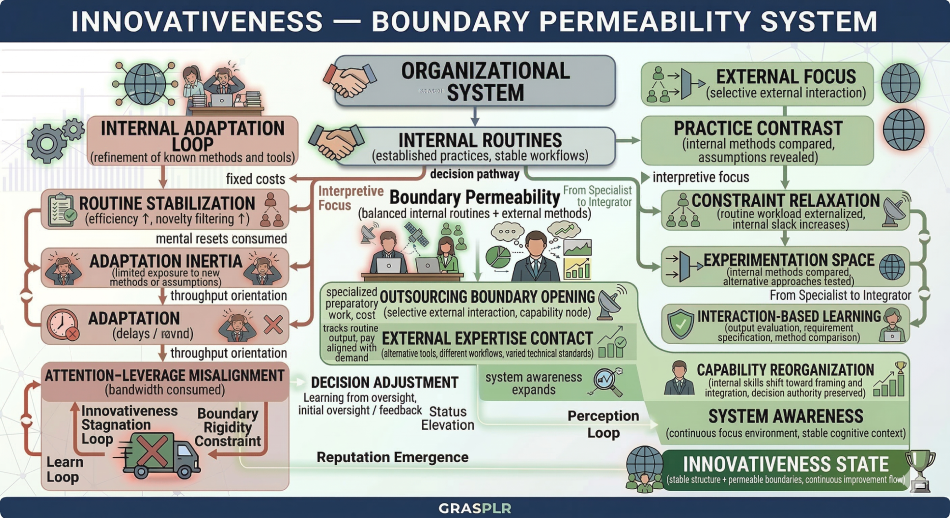
Organizations typically rely on stable internal routines. These routines are efficient, but they also filter out novelty. Over time, teams become well-adapted to yesterday’s problems. When markets, technologies, or customer expectations shift, this adaptation turns into inertia.

Outsourcing interrupts this pattern.
Novelty Through Contact, Not Disruption

When work is entirely internal, learning is endogenous. Teams refine what they already know. Outsourcing introduces exogenous input: different tools, practices, assumptions, and standards.

This exposure does not automatically produce innovation. What it produces is contrast. Employees begin to notice which internal practices are conventions rather than necessities. Some assumptions become visible only when they are violated elsewhere.

In software development, for example, outsourcing specific components to external specialists can expose internal teams to unfamiliar programming languages, architectures, or workflows. The value is not in adopting these wholesale, but in understanding their tradeoffs. Internal teams gain reference points.

Innovation begins as comparison.

Constraint Relaxation and Cognitive Space

A second effect of outsourcing is the release of internal constraints. When teams are fully occupied maintaining existing systems, they have little capacity to explore alternatives. Exploration requires slack: time, attention, and tolerance for uncertainty.

Outsourcing routine or highly specialized tasks creates this slack indirectly. Internal teams are not told to innovate. They are simply less constrained by maintenance demands.

This matters because innovation is often suppressed not by risk aversion, but by saturation. When every hour is allocated to keeping things running, deviation feels irresponsible. Once some of that load is shifted outward, experimentation becomes structurally possible.

The system permits variation without requiring heroics.

Learning as a Structural Side Effect

When employees coordinate with external experts, learning occurs through interaction rather than instruction. They must specify requirements, evaluate outputs, and integrate results. Each of these activities refines judgment.

This form of learning is embedded and practical. Employees learn what questions to ask, where misunderstandings arise, and how different approaches perform under real constraints. These insights persist even if the outsourced relationship ends.

Over time, internal capability does not disappear. It reorganizes. Teams become better at framing problems, selecting tools, and combining approaches. Innovation accelerates because the system becomes more fluent at recombination.

Innovation Without Chaos

There is a risk in equating openness with creativity. Excessive outsourcing or poorly defined interfaces can fragment work and dilute accountability. Innovativeness depends on permeability with structure, not openness alone.

Well-designed outsourcing preserves internal coherence while allowing selective exchange with the outside world. Boundaries are crossed deliberately, not continuously. This keeps experimentation local and reversible.

In such systems, innovation does not feel dramatic. It appears as a steady stream of small improvements, occasional step changes, and faster adaptation to emerging conditions.

Innovativeness as an Emergent Property

Seen through this lens, innovativeness is not a trait to cultivate directly. It is an emergent property of systems that balance stability with exposure.

Outsourcing contributes by adjusting that balance. It introduces new signals without overwhelming existing structure. It creates learning opportunities without requiring constant reinvention.

The seed metaphor holds if treated carefully: growth depends less on exhortation and more on conditions. When boundaries allow the right exchanges to occur, innovation follows as a natural consequence.

Instant Digital Access

Secure download link delivered immediately after purchase

Built for Creators

Systems designed to help you build, not just download.

Global Compatibility

Files and toolkits accessible worldwide, no restrictions