

A company’s status in its industry is often described as the result of visibility, scale, or reputation. But status tends to emerge from something more structural: the organization’s ability to operate effectively across complexity without appearing strained.
An observable pattern appears when organizations grow beyond the limits of their original capabilities. As demands increase, internal teams face terrain they were not designed to navigate alone. New technical requirements, service expectations, and reliability thresholds appear. How the organization responds to this moment largely determines whether its standing improves or erodes.
Outsourcing alters this response by extending capability without requiring internal overreach.
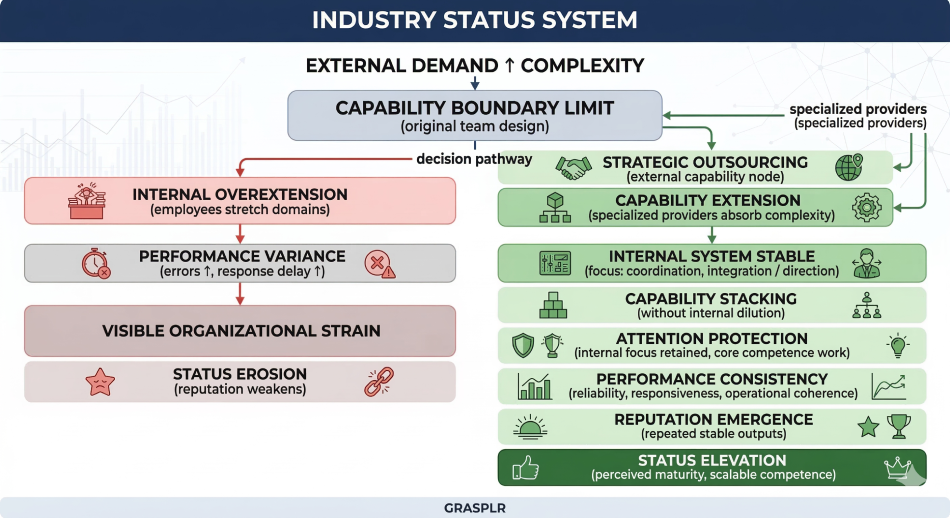
The Structure Beneath Status
Status is not simply how a company is perceived. It is how consistently it performs under pressure. Customers, partners, and competitors infer standing from reliability, responsiveness, and coherence over time.

When employees are forced to stretch across domains that require specialized expertise, performance variability increases. Errors surface. Response times lengthen. The organization may still function, but it does so visibly under strain.
Outsourcing redistributes this strain. Specialized external providers absorb complexity at points where internal capability would otherwise be thin. The internal system remains focused on coordination, integration, and direction rather than execution in unfamiliar terrain.
What changes first is not reputation, but stability.
Capability Stacking Without Dilution
As organizations expand, they face a choice: either internalize every new capability or find ways to access expertise without absorbing it fully.
Internalization increases control but also complexity. Each added function introduces new management overhead, learning curves, and fixed commitments. Over time, this can dilute focus and slow decision-making.
Outsourcing enables capability stacking without dilution. External partners bring depth in specific areas—such as customer support infrastructure, payment systems, or operational scalability—while the core organization remains oriented around its defining competencies.
From the outside, this appears as sophistication. The company handles complexity smoothly, even though much of that complexity is managed beyond its internal boundaries.
Focus as a Signal of Maturity
Organizations with elevated status often exhibit a clear sense of what they are responsible for—and what they are not. This clarity is legible to outsiders.
When employees are not burdened by peripheral operational concerns, they engage more deeply with the work that defines the organization’s identity. Product decisions become more deliberate. Platform improvements align more closely with user needs. Strategic choices reflect long-term orientation rather than short-term firefighting.
Outsourcing contributes to this clarity by protecting internal attention. It allows employees to remain anchored in the organization’s core narrative rather than constantly compensating for missing infrastructure.
Status increases because the organization behaves like one that understands its own boundaries.
Reputation as an Emergent Effect
Reputation is often treated as something to manage directly through branding or communication. In practice, it emerges from repeated exposure to consistent performance.
When outsourcing is used to stabilize operations and extend expertise, performance variability decreases. Customers experience fewer disruptions. Partners encounter clearer interfaces. Growth appears intentional rather than reactive.
Over time, this consistency compounds. The organization is perceived as dependable and capable of operating at scale. Status follows not from signaling, but from observable competence.
Elevation Without Overextension
The climbing metaphor is useful if handled carefully. Elevation does not come from attempting harder terrain alone, but from assembling the right support structures to make ascent sustainable.
Outsourcing functions as part of this support system. It does not replace internal strength, but prevents that strength from being misapplied. Employees remain effective where their judgment matters most, while external expertise handles specialized load.
In this configuration, status rises quietly. The organization does not announce its maturity; it demonstrates it.

