

Software capability inside organizations is often treated as something to own: licenses purchased, systems installed, teams trained. Over time, this creates a dense internal stack—powerful, but heavy. Each additional capability adds maintenance obligations, learning curves, and long-term commitments, regardless of how frequently it is used.
A simple observation clarifies the tradeoff. Many software needs are episodic. They arise in response to specific client requests, market experiments, or short-lived opportunities. Treating these needs as permanent infrastructure creates mismatch between duration of use and duration of ownership.
Outsourcing software extension intervenes at this mismatch.
Capability Without Accumulation
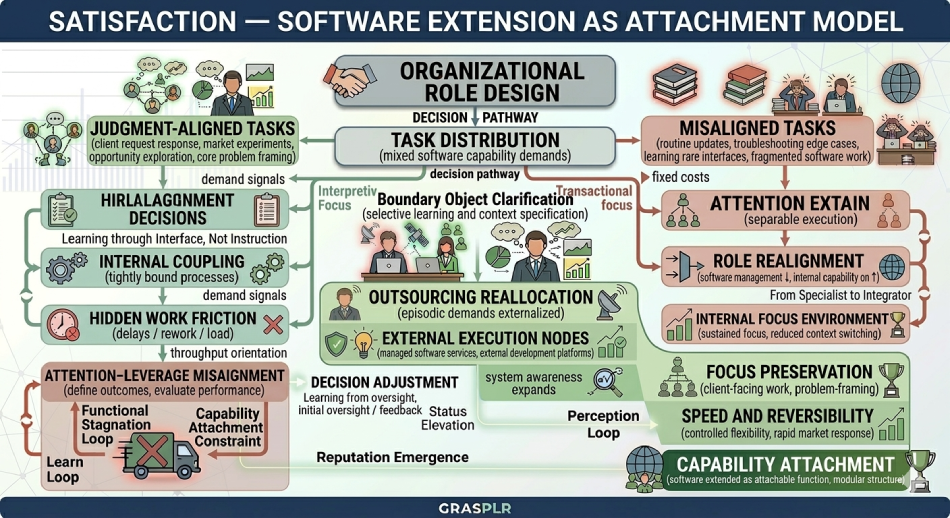
When a company outsources a software extension—whether through external development teams, specialized platforms, or managed services—it gains access to functionality without absorbing it into its permanent structure.
This is less about cost avoidance and more about structural lightness. Internal systems remain focused on their core purpose, while peripheral or temporary capabilities are attached and detached as needed.
The rented-tool metaphor is useful if treated precisely. The value is not just saving money, but avoiding clutter. The organization’s internal “toolbox” remains coherent rather than overfilled with rarely used instruments that still require upkeep.
This coherence reduces friction over time.
Speed as a Structural Advantage
One consequence of outsourcing software extension is reduced lead time. Internal development or procurement often involves justification cycles, integration planning, and long-term support considerations. These steps make sense for core systems, but they slow response when needs are uncertain or exploratory.
External software extension shortens this cycle. Capabilities can be tested in real conditions before the organization commits to internalizing them. If demand persists, the capability can later be absorbed. If not, it can be released without significant residue.
This reversibility matters in volatile environments. The organization can move without locking itself into yesterday’s assumptions.
Focus Preservation Inside the System
Another effect of outsourcing software extension is protection of internal attention. When employees are asked to maintain tools outside their core expertise, cognitive load increases. They spend time learning interfaces, managing updates, and troubleshooting edge cases that add little strategic value.
By contrast, when specialized software work is handled externally, internal teams interact with it primarily at the interface level. They focus on what the software enables rather than how it is built or maintained.
This preserves focus on client-facing and integrative work: framing problems, interpreting results, and coordinating outcomes. The organization remains oriented toward value creation rather than tool stewardship.
Software as a Boundary Object
Externally extended software often functions as a boundary object: a shared system that connects different capabilities without fully merging them. It allows collaboration between internal teams and external specialists without collapsing roles.
This arrangement clarifies responsibility. Internal teams define goals and evaluate outcomes. External providers manage implementation details and technical depth. Learning still occurs, but it is selective and contextual rather than exhaustive.
Over time, this supports skill development without overload. Employees become better at specifying needs and assessing quality, even if they do not internalize every technical detail.
Adaptability Without Fragmentation
A common risk in extending software externally is fragmentation—too many tools, poorly integrated. This risk is real, but it is not inherent to outsourcing. It arises when boundaries are unclear and extensions accumulate without review.
When managed deliberately, outsourced software extension increases adaptability without destabilizing the system. Capabilities are added with intent, connected through defined interfaces, and evaluated against actual use.
The organization remains modular rather than monolithic.
Software Extension as Structural Choice
Seen systemically, outsourcing software extension is not primarily a technology decision. It is a structural one.
It determines how long capabilities are held, where complexity lives, and how reversible strategic moves are. Organizations that treat software as permanently owned infrastructure tend to become slower over time. Those that treat some software as attachable capability remain lighter.
The result is not constant change, but controlled flexibility.

