
Job expansion is often framed as a reward: broader scope, higher responsibility, increased compensation. But structurally, job expansion does not begin with recognition. It begins when the composition of work inside a role changes.
A recurring pattern appears in roles that feel “stuck.” Employees are busy, deadlines are tight, and performance is acceptable, yet responsibilities do not meaningfully expand. The limiting factor is rarely capability. It is capacity. When execution work fills the available bandwidth, there is no space for higher-order responsibility to take root.
Outsourcing alters this condition by redistributing execution load.
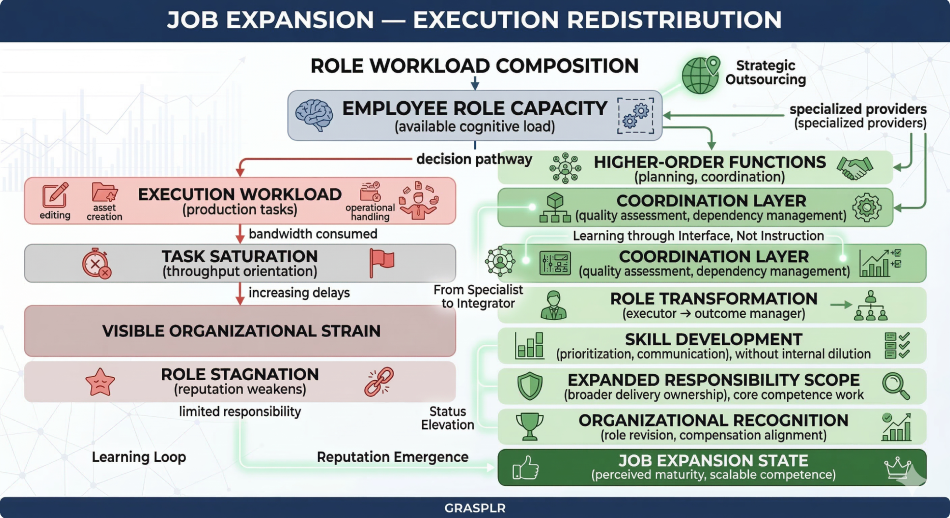
From Task Saturation to Role Headroom
In many roles, especially in growing organizations, employees are evaluated on outcomes while being saturated with production tasks. Design, coordination, planning, and evaluation are squeezed between deliverables. Even when individuals have the potential to operate at a higher level, the structure of work prevents it.

Outsourcing routine or specialized tasks introduces headroom into the role. This headroom is not idle time. It is structural space where new responsibilities can emerge.
Employees begin to coordinate rather than execute every component themselves. They make sequencing decisions, manage dependencies, and assess quality across contributions. Their role shifts from doing work to shaping how work gets done.
This shift is the basis of job expansion.
The Chef Analogy, Structurally
The chef-and-sous-chef analogy works when interpreted as a system, not a hierarchy. The presence of a sous chef does not reduce the chef’s importance. It changes the nature of the chef’s work.
Preparation is handled elsewhere, allowing the chef to focus on composition, timing, and consistency. Responsibility increases rather than decreases. The chef becomes accountable for the whole experience, not just individual actions.
Outsourcing functions similarly in organizational roles. Execution support enables employees to take ownership of broader outcomes. Their judgment carries more weight because it operates at a higher level of integration.
Job expansion follows responsibility, not workload.
Skill Expansion as a Consequence
As roles expand through coordination and oversight, skill requirements change. Employees develop capabilities in planning, prioritization, communication, and evaluation. These skills are difficult to cultivate in execution-heavy roles because they require perspective rather than throughput.
Importantly, this development is not abstract. It is embedded in real delivery contexts. Employees learn to manage timelines, reconcile tradeoffs, and integrate contributions from multiple sources.
In the marketing campaign example, outsourcing design and editing work allows the internal team to operate as integrators. They shape narrative, manage coherence across channels, and ensure alignment with strategic goals. Their work becomes less about producing assets and more about directing outcomes.
This transition supports legitimate role expansion because it increases the scope of responsibility and impact.
Recognition and Remuneration Follow Structure
Compensation changes are often framed as motivational levers. In practice, they tend to follow structural changes in responsibility.
When employees demonstrably operate at a higher level—managing broader scope, reducing delivery risk, and improving outcomes—the organization has clearer justification for role revision. The expansion is visible and defensible because it is grounded in changed work structure.
Outsourcing makes this visible by externalizing part of the execution. What remains inside the role is easier to evaluate as higher-order contribution rather than raw effort.
Job expansion becomes legible to the organization.
Expansion Without Overextension
There is a risk in mistaking job expansion for job inflation. Expanding responsibility without adjusting workload simply increases pressure. Outsourcing avoids this by removing tasks rather than adding expectations.
The goal is not to do more, but to do different work.
When outsourcing is aligned with role design, employees are not stretched thinner. They are elevated into roles that require judgment, coordination, and synthesis. These roles scale better over time and are less vulnerable to burnout.
Job Expansion as System Output
Seen systemically, job expansion is not a policy or promise. It is an output of how work is distributed.
Outsourcing contributes by carving execution away from roles that are ready to grow. It allows employees to operate at the edge of their capability without being buried by volume.
The result is a workforce where expanded roles emerge naturally, supported by structure rather than aspiration.