
Job enrichment is often described as adding variety or challenge to a role. But in practice, enrichment is less about adding new elements and more about removing the ones that obscure meaningful work.
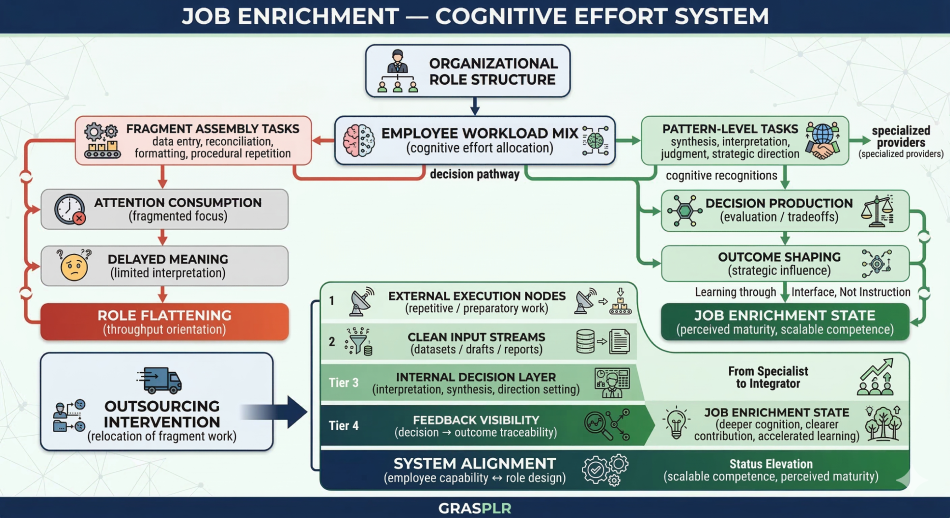
A simple observation makes this visible. In many roles, employees are capable of higher-level contribution, yet spend much of their time assembling fragments: entering data, reconciling sources, formatting outputs, or repeating procedural steps. These activities are necessary, but they dominate attention in ways that flatten the role.
The result is not boredom alone. It is underutilization.
Outsourcing changes this distribution of effort.
From Fragment Assembly to Pattern Recognition
The puzzle analogy is helpful when interpreted structurally. Completing a complex picture requires not just placing pieces, but recognizing emerging patterns. When a single person is responsible for both sorting fragments and assembling meaning, pattern recognition is delayed.
In organizational roles, repetitive and preparatory tasks act like scattered puzzle pieces. They consume time and attention, leaving less capacity for synthesis, interpretation, and judgment.
Outsourcing these tasks does not eliminate work. It reassigns fragmentation elsewhere, allowing internal roles to operate closer to pattern-level thinking. Employees spend more time connecting ideas, shaping direction, and evaluating tradeoffs.
This shift is central to job enrichment.
Enrichment Through Depth, Not Variety
Job enrichment is often confused with job enlargement. Adding more tasks does not enrich a role if those tasks operate at the same level of abstraction.
Enrichment occurs when the work moves upward in cognitive depth. Employees engage more frequently with questions of “why,” “how,” and “what next,” rather than only “what now.”
By outsourcing repetitive or low-judgment tasks, organizations make this upward movement possible. The role becomes less about throughput and more about meaning-making within constraints.
In a marketing context, this is the difference between compiling research and interpreting it. Between formatting assets and shaping narrative. Between executing instructions and refining strategy.
The role feels richer because it operates where judgment matters.
Feedback Loops and Fulfillment
Another structural feature of enriched roles is clearer feedback. When employees work on higher-level tasks, the connection between decisions and outcomes becomes more visible.
Outsourced tasks often produce clean inputs: data sets, reports, drafts. Internal teams then make choices based on these inputs. When results follow, employees can trace success or failure back to their decisions rather than to execution volume.
This strengthens feedback loops. Learning accelerates. A sense of accomplishment emerges not from effort alone, but from discernible impact.
Fulfillment, in this sense, is not emotional encouragement. It is informational clarity.
Growth Without Overload
One reason job enrichment initiatives fail is that they are layered on top of existing workloads. Employees are asked to think more deeply while still handling the same volume of routine work. Pressure increases, and enrichment collapses into exhaustion.
Outsourcing avoids this trap by subtracting before adding. It creates space rather than stacking expectations.
Employees are not stretched thinner. They are repositioned. Their work becomes more challenging in kind, not heavier in quantity.
This repositioning supports sustainable growth rather than temporary engagement.
Job Enrichment as Role Design
Seen systemically, job enrichment is not a perk or program. It is an outcome of role design.
Roles are enriched when they concentrate judgment, responsibility, and learning while minimizing unnecessary fragmentation. Outsourcing contributes by relocating repetitive and preparatory work to parts of the system better suited to handle it.
The organization benefits through improved quality and retention. Employees benefit through clearer contribution and skill development.
The system benefits through alignment.