
Quality and quantity are often treated as opposing objectives. One is associated with care and precision, the other with speed and scale. Organizations frequently assume that increasing one necessarily degrades the other.
Yet when quality and quantity rise together, the cause is rarely extra effort. It is almost always structural.
A useful observation comes from coordinated team environments. In complex systems, not every participant needs to see the whole field. But someone—or something—must. Without that coordinating function, activity increases while coherence declines.
In organizations, outsourcing can play a role similar to this coordinating layer.
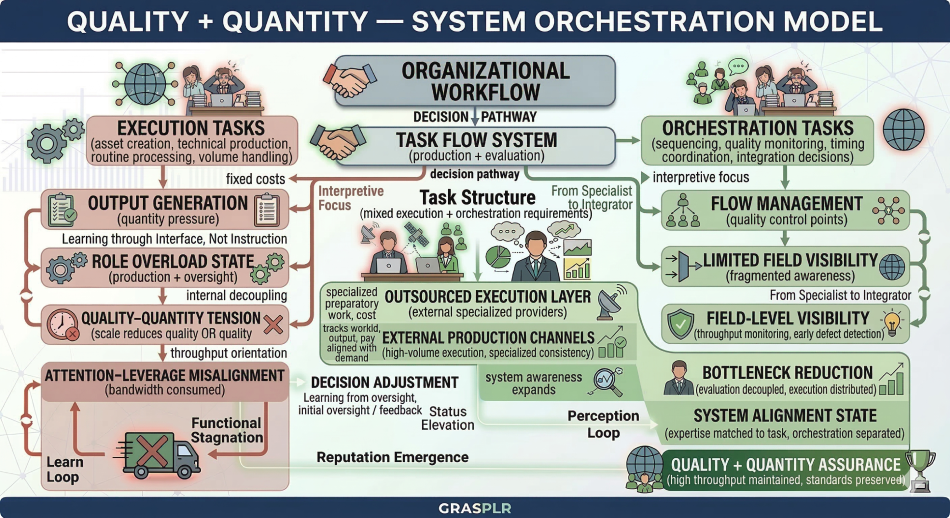
Quality and Quantity Are Not Task Properties
Quality and quantity do not reside in individual tasks. They emerge from how tasks are sequenced, reviewed, and integrated.

When employees are responsible for both producing outputs and maintaining the flow of work, two failure modes appear. Either quality suffers under volume pressure, or volume collapses under quality checks. The tension is not a failure of discipline; it is a consequence of overloaded roles.
Outsourcing redistributes this tension.
By assigning execution-heavy or highly specialized tasks to external providers, the internal system separates production from orchestration. Output can scale without overwhelming those responsible for direction and integration.
The result is not balance by compromise, but by differentiation.
Seeing the Field
The quarterback analogy is useful if interpreted structurally rather than heroically. The quarterback does not perform every action. Their value lies in field awareness, timing, and decision-making under constraint.
Similarly, when organizations outsource execution tasks, internal teams gain the ability to observe patterns rather than manage fragments. They track throughput, quality signals, and timing dependencies without being submerged in production details.
This field-level visibility is essential for both quality and quantity. It allows early correction when standards slip and early acceleration when capacity is underutilized.
Without this perspective, organizations oscillate between overproduction and rework.
Expertise at the Right Layer
Another contributor to assurance is alignment between task type and expertise.
Specialized external providers often deliver higher consistency in narrowly defined domains—design, editing, production, or processing—because repetition and focus are built into their operating model. Quality improves because execution is handled by those optimized for it.
At the same time, internal teams focus on coherence across outputs. They ensure that individual components align with strategy, audience, and timing. Quantity increases because fewer cycles are lost reconciling mismatched work.
This layered expertise supports assurance without micromanagement.
Throughput Without Degradation
Quantity problems often arise not from insufficient capacity, but from bottlenecks created by review and correction. When internal teams are stretched thin, outputs pile up faster than they can be evaluated. Quality issues are detected late, when correction is expensive.
Outsourcing shifts some of this load outward. External partners handle volume, while internal teams manage checkpoints rather than every step. Feedback loops shorten because fewer decisions are congested at the center.
Throughput increases not because work moves faster everywhere, but because it stops waiting in the wrong places.
Assurance as a System Property
Quality assurance and quantity assurance are often implemented as controls: checklists, quotas, audits. These are necessary, but insufficient.
True assurance emerges when the system makes it easier to do the right amount of work at the right level of quality. Outsourcing contributes by redistributing effort so that judgment is applied where it has the highest leverage.
Internal teams do not chase defects or volume targets. They shape conditions under which both stabilize.
This is the difference between supervision and orchestration.
The Hidden Tradeoff That Disappears
When quality and quantity are in conflict, the system is usually misaligned. Tasks are coupled that should be separated, or decisions are centralized that require local context.
Outsourcing resolves some of these misalignments by creating distance where closeness creates overload. It allows execution to scale while preserving the integrity of decision-making.
What appears as assurance is, in fact, alignment.