

Call us toll free: +64 226953063

Instant worldwide digital delivery — no waiting

GRASPLR Help & Support

Employee Empowerment as Boundary-Control Redistribution

Employee empowerment is often framed as motivation or trust. But in operational terms, empowerment is less about sentiment and more about who controls boundaries: what work stays inside a role, what moves outside, and who decides.

A visible pattern appears in small and mid-sized organizations under growth pressure. Employees are capable and committed, yet much of their time is spent managing constraints rather than outcomes. They wait for resources, stretch across unfamiliar tasks, or compensate for missing capacity. Authority exists, but it is thinly spread across too many obligations.

Outsourcing changes this by relocating certain constraints beyond the individual role.
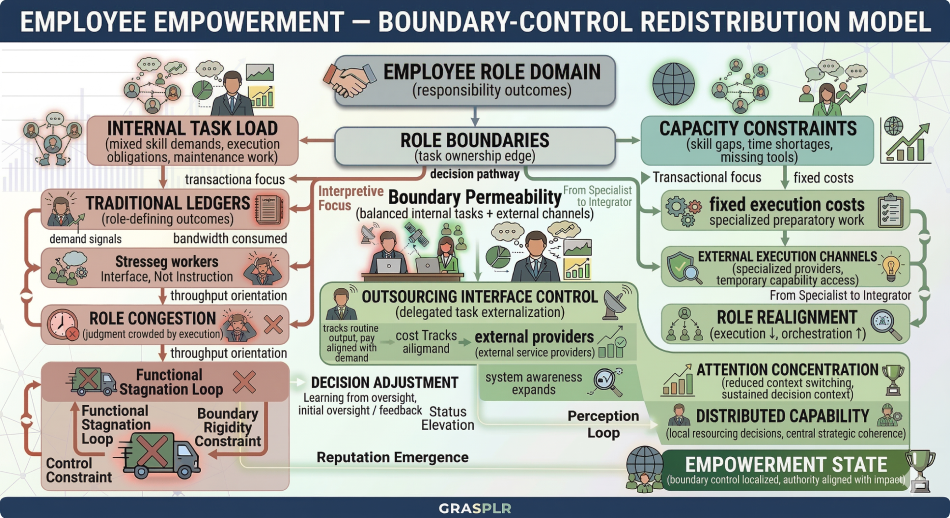
Empowerment as Control Over Interfaces

When employees are allowed to outsource specific tasks, they gain control over interfaces rather than over people. This distinction matters.

Instead of requesting additional internal support or escalating capacity issues upward, employees can directly shape how work enters and exits their domain. They decide what to delegate, how to specify it, and how to integrate the result. Their influence shifts from execution to orchestration.

This form of empowerment is practical rather than symbolic. It gives employees leverage where it affects outcomes, without requiring broader authority over budgets, headcount, or strategy.

The role becomes more complete, not more autonomous in the abstract.

Access Without Internalization

Outsourcing gives employees access to skills and tools that would be inefficient to internalize permanently. Design, development, research, or specialized production can be brought in when needed and released when no longer relevant.

From a systems perspective, this prevents role inflation. Employees are not forced to become partial experts in everything. Instead, they become skilled at framing problems, selecting resources, and evaluating outputs.

Empowerment here does not mean doing more personally. It means shaping the system through which work gets done.

This distinction often determines whether empowerment scales or collapses under complexity.

Focus as a Structural Outcome

One of the quieter effects of outsourcing is focus preservation. When employees can externalize execution-heavy or highly specialized tasks, their attention remains concentrated on work that requires context, judgment, and continuity.

This focus is not created through discipline or time management. It is created by removing structural interference.

As a result, employees operate with greater clarity about priorities. They spend less time context-switching and more time integrating information across decisions. Their contribution becomes more visible and easier to evaluate.

Empowerment follows because impact becomes legible.

Risks as Design Signals

Outsourcing does introduce risks: misalignment, quality variance, ethical concerns, and dependency. These risks are often cited as reasons to centralize control.

From a systems view, these risks are design signals. They indicate where boundaries are unclear, incentives misaligned, or feedback loops too slow.

When employees are empowered to outsource responsibly, the organization must clarify values, standards, and escalation paths. This clarity benefits the entire system, not just outsourcing relationships.

Empowerment is sustained not by surveillance, but by well-defined constraints that make responsible action easier than irresponsible action.

Distributed Capability, Central Coherence

Organizations that use outsourcing effectively tend to show a specific pattern: distributed capability with central coherence.

Employees make local decisions about resourcing and execution, while leadership maintains alignment through shared goals, standards, and integration mechanisms. The system adapts without fragmenting.

Empowerment emerges because employees are trusted with decisions that match their context, and constrained where decisions affect the whole.

Outsourcing acts as a catalyst for this distribution. It forces explicit boundary-setting and makes decision rights visible.

Empowerment as a System Property

Seen systemically, empowering employees through outsourcing is not about granting freedom. It is about redesigning roles so that authority, responsibility, and capacity are better aligned.

Employees feel empowered when they can act on what they know without constantly compensating for missing resources. Outsourcing provides one way to close that gap.

The result is not a dramatic transformation, but a steadier system where employees can shape outcomes rather than work around constraints.

Instant Digital Access

Secure download link delivered immediately after purchase

Built for Creators

Systems designed to help you build, not just download.

Global Compatibility

Files and toolkits accessible worldwide, no restrictions