
Employee empowerment is often described in terms of trust, autonomy, or motivation. These descriptions are accurate but incomplete. Empowerment becomes durable only when it is supported by structural mechanisms that allow employees to act on their judgment without repeatedly encountering capacity limits.
One observable moment makes this clear. An employee recognizes what needs to be done but cannot proceed because the required time, skill, or tool is unavailable internally. The insight exists, but the system does not allow it to be acted upon. Over time, this gap erodes initiative more effectively than any lack of encouragement.
Outsourcing changes this condition by redistributing access to resources.
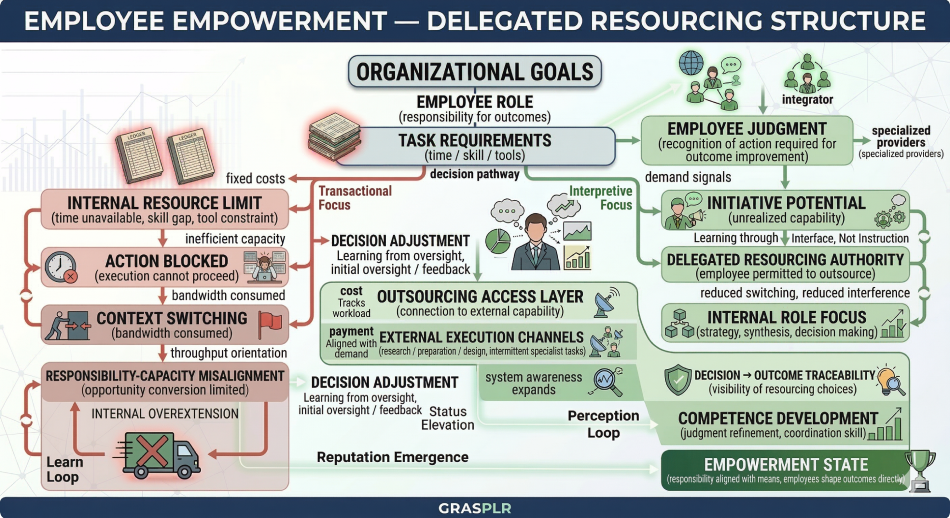
Empowerment as Responsibility with Means
Giving employees the ability to outsource is not simply giving permission. It is assigning responsibility together with the means to fulfill it.
The car-key analogy works when interpreted structurally. Handing over the keys signals that the driver is trusted not just to move, but to navigate within rules, constraints, and shared objectives. The driver does not choose the destination alone, but they control how to get there.

Similarly, employees empowered to outsource are not detached from organizational goals. They are given discretion over how work is resourced and sequenced within those goals. This discretion allows them to convert judgment into action without unnecessary escalation.
Empowerment emerges because responsibility and capacity are aligned.
Outsourcing as an Access Layer
Outsourcing functions as an access layer between internal roles and external capability. It allows employees to reach beyond the immediate boundaries of the organization without permanently expanding those boundaries.
This access matters because many tasks do not justify internal specialization. Research bursts, data preparation, design variations, or content distribution often appear intermittently. Internalizing them would add fixed complexity. Ignoring them would constrain output quality.
By outsourcing such work, employees maintain momentum. They can pursue higher-level tasks—strategy, synthesis, decision-making—while ensuring that necessary supporting work is completed competently.
The organization gains leverage without accumulation.
Fresh Inputs Without Structural Disruption
Another effect of outsourcing is the introduction of variation. External contributors bring different methods, assumptions, and reference points. This variation does not automatically produce innovation, but it does expose internal routines to comparison.
Employees coordinating outsourced work encounter alternative ways of framing problems and executing solutions. Over time, this broadens their perspective without requiring wholesale change.
Importantly, this exposure is filtered. Employees decide what to adopt, adapt, or discard. Empowerment here lies in selection, not absorption.
Risk as a Design Consideration
Outsourcing introduces real risks: misalignment, inconsistent quality, ethical concerns, and dependency. Treating these risks as reasons to withhold empowerment often leads to over-centralization and bottlenecks.
From a systems perspective, these risks signal where structure is incomplete. Clear guidelines, defined interfaces, and fast feedback loops reduce risk more effectively than restricting decision rights.
When employees understand values, standards, and escalation paths, they can exercise outsourcing authority responsibly. Empowerment becomes a managed capability rather than an uncontrolled one.
Trust, in this sense, is not blind. It is supported by design.
Empowerment Through Visibility
One of the quieter effects of outsourcing authority is increased visibility of contribution. When employees decide how work is resourced, their decisions become traceable to outcomes. Successes and failures are easier to interpret.
This traceability strengthens accountability without adding surveillance. Employees see the impact of their choices and refine their judgment accordingly. Learning accelerates because feedback is tied to decisions, not just effort.
Empowerment stabilizes because it produces competence, not just freedom.
Empowerment as a System Property
Seen systemically, empowering employees through outsourcing is not about generosity or control. It is about designing roles that can respond to reality without constant friction.
When employees can access external capability within clear boundaries, they stop working around constraints and start shaping outcomes. Productivity and innovation follow not because people are inspired, but because the system no longer blocks effective action.
Empowerment, in this form, is quiet, practical, and resilient.