

Call us toll free: +64 226953063

Instant worldwide digital delivery — no waiting

GRASPLR Help & Support

Empowerment Through Outsourcing as Role Boundary Design

“How to empower employees” is often interpreted as a question of management technique. In practice, empowerment emerges less from what leaders say and more from how roles are constructed and constrained.

Outsourcing becomes relevant at the moment when employees are capable of higher-level contribution but remain occupied by work that fragments their attention. The observable signal is not low performance, but congestion: skilled people spending time on tasks that dilute judgment rather than sharpen it.

Empowerment, in this context, is not about removing oversight. It is about redesigning boundaries so that employees can operate where their contribution has the most leverage.
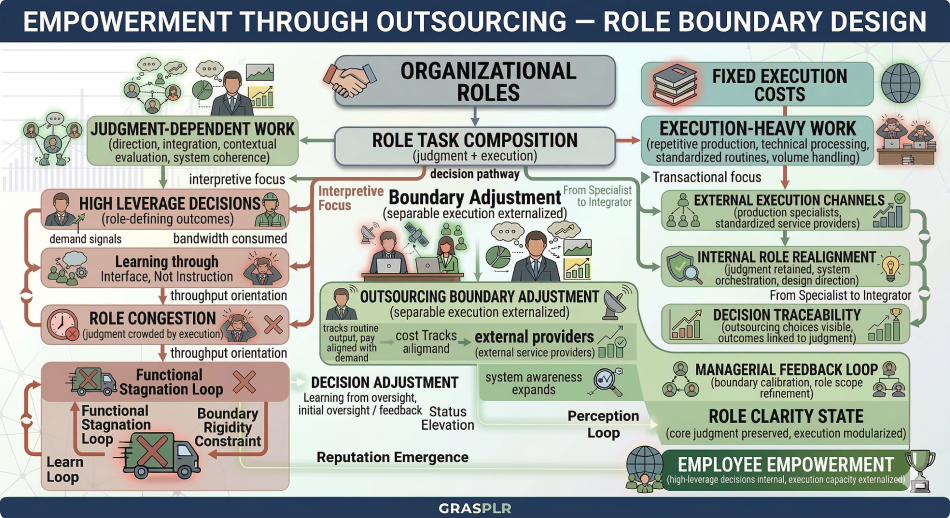
Outsourcing as Boundary Adjustment

When employees are allowed to outsource certain categories of work, the boundary of their role shifts. Execution-heavy or highly repeatable tasks move outward. What remains inside the role is work that depends on context, taste, sequencing, or integration.

In the marketing agency example, graphic designers retain ownership of brand coherence and design direction while external contributors handle production-scale variations. The internal role becomes more architectural. Designers are no longer just producing assets; they are shaping systems of visual expression.

This is empowerment by design, not by declaration.

What Determines Whether Empowerment Holds

Not all outsourcing produces empowerment. The difference lies in how boundaries are drawn.

When employees outsource tasks that are clearly defined, low in strategic sensitivity, and separable from core judgment, empowerment tends to increase. Their time shifts toward decisions that matter. Their accountability becomes clearer because outcomes are more directly tied to their choices rather than their throughput.

When outsourcing crosses into work that defines the role’s unique value, empowerment collapses. The role empties out instead of expanding. This is not a moral failure; it is a boundary error.

Empowerment depends on keeping judgment inside the role while allowing execution to move outward.

Guidelines as Structural Signals

Discussions about “rules for outsourcing” are often framed as control mechanisms. Structurally, they function as signals about what the organization considers core versus supportive work.

Clear guidelines reduce ambiguity. Employees do not have to guess whether a task should be kept or delegated. This clarity lowers coordination costs and reduces hesitation. Outsourcing becomes a normal part of work design rather than an exception requiring justification.

Transparency here is not about monitoring. It is about making role logic explicit.

Trust as a System Condition

Trust is frequently described as a cultural trait. In operational systems, trust emerges when actions are predictable and outcomes are legible.

When employees are empowered to outsource within clear boundaries, their decisions become easier to evaluate. Managers can see how judgment was applied without micromanaging execution. Feedback focuses on decisions rather than effort.

This traceability supports trust because it reduces the need for inference. Empowerment becomes sustainable because it is observable.

Chess, Not Checkers

The chess metaphor is useful when treated structurally. In chess, power does not come from moving pieces freely. It comes from understanding constraints, timing, and interaction effects.

Outsourcing, when used to empower employees, functions the same way. Each move changes the configuration of the system. Poorly timed or poorly bounded moves create exposure. Well-considered moves open space for more effective action.

Empowerment lies in being able to make those moves with understanding, not in moving without limits.

Empowerment as an Outcome, Not a Program

Seen systemically, empowering employees through outsourcing is not a checklist or rollout. It is an outcome of role clarity, boundary discipline, and decision alignment.

Employees feel empowered when they can shape outcomes without constantly compensating for missing capacity. Outsourcing provides one mechanism for closing that gap, provided it is designed around judgment rather than volume.

When this alignment holds, productivity and innovation tend to rise quietly—not because people are told to do more, but because the system finally lets them do what they are already capable of.

Instant Digital Access

Secure download link delivered immediately after purchase

Built for Creators

Systems designed to help you build, not just download.

Global Compatibility

Files and toolkits accessible worldwide, no restrictions