

Call us toll free: +64 226953063

Instant worldwide digital delivery — no waiting

GRASPLR Help & Support

Direction 1: What Orientation Really Means in a System

Most systems don’t fail because people stop trying.

Teams work hard. Individuals stay busy. Projects keep moving. Yet after months of effort, the outcome still feels misaligned with what was originally intended.

The confusion usually isn’t about effort. It’s about direction.

When a system doesn’t clearly define what it is oriented toward protecting or prioritizing, activity continues – but the results slowly drift away from the intended outcome.
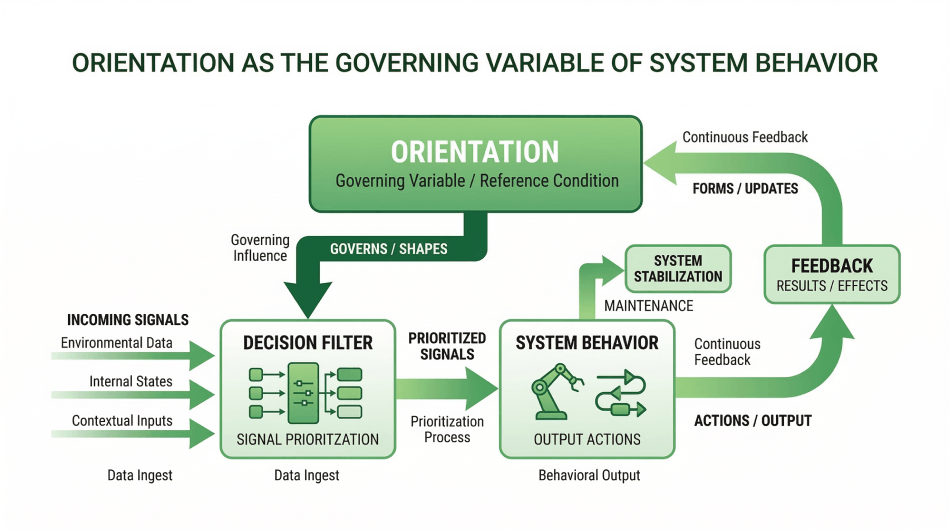
What Orientation Really Means in a System

Systems Layer

In Systems Language, orientation is the governing variable that determines which signals a system treats as important and which signals it ignores.

Orientation functions as the system’s directional constraint. It establishes the reference condition that guides decision filtering, attention allocation, and response behavior.

Every system must resolve competing signals from its environment. Because processing capacity is limited, the system cannot respond to everything equally. Orientation provides the rule that resolves this competition.

Once orientation is established, the system begins to stabilize around the signals that reinforce that direction. Behaviors, decisions, and feedback loops gradually align to support what the system is implicitly trying to protect.

When orientation is unclear, unstable, or conflicting, the system lacks a stable reference point. Signals compete without a clear hierarchy, causing decision pathways to diverge and behaviors to drift.

High effort does not correct this condition. Increased activity simply accelerates the system along inconsistent paths.

Structural Translation

In simple terms, orientation determines what the system believes matters most.

It answers a fundamental structural question:

What are we trying to protect or prioritize?

When that answer is clear, decisions become easier. The system knows which signals deserve attention and which ones can be ignored.

When that answer is unclear, people start interpreting priorities differently. One group may prioritize speed, another may prioritize safety, and another may prioritize cost. Everyone may be working hard, but they are working toward slightly different goals.

Over time, those small differences accumulate. The system begins to drift.

Structural Implication

In real environments – organizations, teams, workflows – unclear orientation produces a predictable pattern.

Effort increases while coherence decreases.

Individuals attempt to compensate by working harder, adding meetings, creating new procedures, or introducing more oversight. But these adjustments operate inside the same structural ambiguity.

Without a stable orientation, the system continuously reinterprets its priorities. Decisions shift depending on who is speaking, which problem is most visible, or what pressure is strongest at the moment.

The result is not failure through inactivity.

It is drift through misaligned effort.

Leverage Insight

Orientation is the directional anchor of a system.

When orientation is clear, effort compounds in one direction.
When orientation is unclear, effort amplifies drift.

In the five-pillar framework, Orientation defines the direction that allows all other leverage to function.

Without orientation, capacity, language, outsourcing, and tools cannot stabilize the system.

Instant Digital Access

Secure download link delivered immediately after purchase

Built for Creators

Systems designed to help you build, not just download.

Global Compatibility

Files and toolkits accessible worldwide, no restrictions