

Call us toll free: +64 226953063

Instant worldwide digital delivery — no waiting

GRASPLR Help & Support

Direction 2: Governing Variables – The Hidden Drivers of Every Decision

Two teams can face the exact same situation and make completely different decisions.

One team moves quickly, prioritizing speed and experimentation. Another moves cautiously, focusing on accuracy and risk reduction. Both teams may be intelligent, capable, and well-intentioned. Yet their strategies and outcomes diverge almost immediately.

From the outside, it may appear that the difference comes from personalities, leadership style, or culture. But often the real difference sits deeper in the structure of the system itself.

Beneath visible actions are hidden assumptions about what must be protected or prioritized. These assumptions quietly shape how decisions are made.
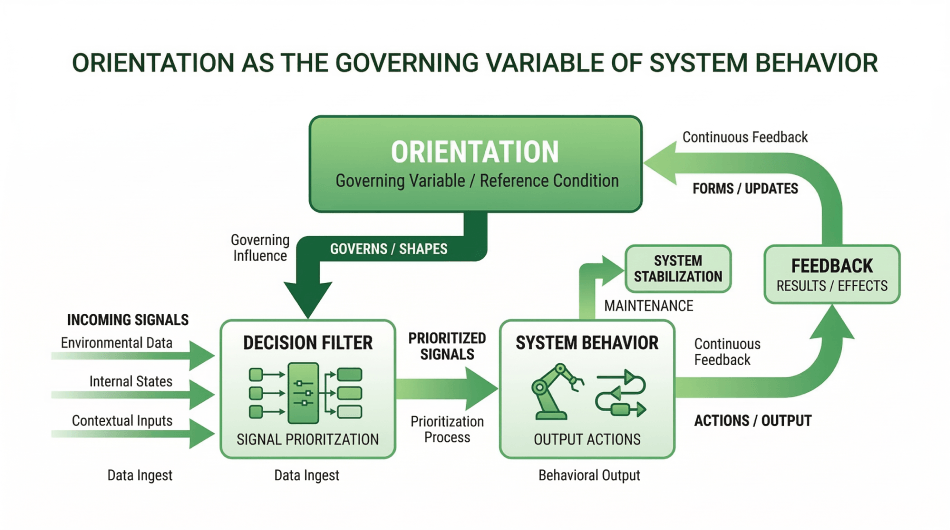
Governing Variables: The Hidden Drivers of Every Decision

Systems Layer

In Systems Language, these assumptions are known as governing variables.

A governing variable is a structural condition that defines what the system attempts to maintain, protect, or optimize during operation.

Every decision system operates under multiple constraints: time, resources, uncertainty, risk, and competing objectives. Governing variables function as the control parameters that resolve these tensions.

They determine which trade-offs the system is willing to make.

For example, if a system’s governing variable prioritizes speed, the decision filter will accept higher levels of uncertainty or error. If the governing variable prioritizes risk control, the system will tolerate slower progress in order to maintain stability.

Because governing variables sit upstream of behavior, they influence how signals are interpreted, how options are evaluated, and which actions appear acceptable.

They rarely appear explicitly in procedures or instructions. Instead, they operate quietly through repeated decision patterns.

Structural Translation

In simple terms, governing variables are the rules that determine what matters most when choices must be made.

When a team decides between speed and accuracy, cost and quality, or innovation and stability, they are responding to the governing variables embedded in their system.

Most people assume decisions are made case by case. But in reality, many of those choices have already been shaped by the system’s underlying priorities.

These priorities guide behavior even when nobody explicitly states them.

That is why teams often behave consistently over time. The governing variables are silently guiding their decisions.

Structural Implication

When governing variables remain implicit or unexamined, systems can produce outcomes that surprise the people inside them.

Leaders may believe the system prioritizes innovation, while its actual governing variables reward predictability and risk avoidance. Teams may say quality matters most, while operational incentives consistently reward speed.

In these situations, behavior appears contradictory. But from a systems perspective, the system is behaving consistently with its governing variables.

The confusion occurs because the stated priorities and the structural priorities are different.

Until governing variables are made visible, attempts to change behavior usually fail. The system simply continues optimizing for the variables that actually control it.

Leverage Insight

Governing variables are the hidden drivers of system behavior.

Change rarely occurs by asking people to behave differently. It occurs by identifying and adjusting the variables the system is structured to protect.

Within the five-pillar framework, this sits at the core of Orientation.

Orientation defines which governing variables the system stabilizes around, and those variables ultimately determine how the system behaves.

Instant Digital Access

Secure download link delivered immediately after purchase

Built for Creators

Systems designed to help you build, not just download.

Global Compatibility

Files and toolkits accessible worldwide, no restrictions