

When something goes wrong in an organization, the first reaction is usually the same.
People assume the problem is execution.
Maybe the team didn’t follow the process correctly. Maybe communication broke down. Maybe someone made a mistake. The response is often to add new procedures, more oversight, or additional training.
Yet sometimes the same types of problems keep reappearing – even after the process has been improved.
When that happens, the issue may not be execution at all.
The issue may be direction.
Systems Layer
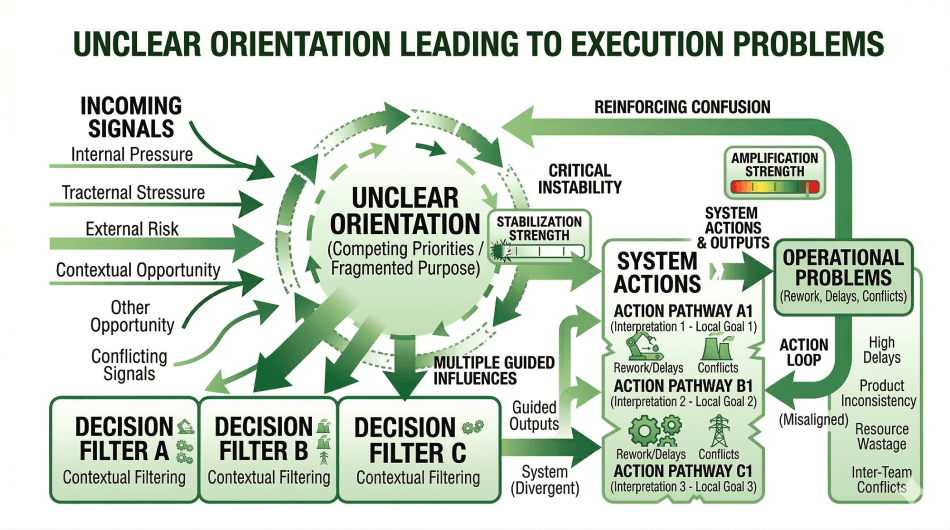
In Systems Language, many operational problems originate from orientation failures rather than execution failures.
Orientation establishes the governing variable that determines which outcomes the system attempts to protect or prioritize. It shapes how signals are interpreted and how decisions are filtered.

When orientation is clear, execution problems tend to appear as isolated deviations. The system can identify them quickly because the reference condition is stable.
However, when orientation is unclear or inconsistent, the system cannot reliably determine what correct execution actually looks like.
Different parts of the system begin interpreting priorities differently. Decision filters vary across teams, roles, or individuals. What appears to be an execution mistake in one context may appear to be a correct decision in another.
Under these conditions, the system generates recurring operational friction: rework, conflicting decisions, inconsistent results, and coordination breakdowns.
The system is not necessarily executing poorly.
It is executing different interpretations of direction.
Structural Translation
In simple terms, many operational problems occur because people are trying to do the right thing according to different definitions of “right.”
When direction is clear, execution becomes easier. People understand which outcomes matter most and how to prioritize competing demands.
But when direction is unclear, individuals fill in the gaps themselves. One team may prioritize speed. Another may prioritize risk reduction. Another may prioritize customer satisfaction.
Everyone may be working hard and following the process – yet the results still conflict.
What appears to be poor execution is often misaligned interpretation of priorities.
Structural Implication
In organizations, orientation failures often trigger the wrong response.
Because the symptoms appear operational – missed deadlines, inconsistent decisions, repeated mistakes – leaders attempt to correct them through tighter processes or increased supervision.
But these interventions operate downstream of the real issue.
If the system’s orientation remains unclear, new processes simply add complexity while the underlying misalignment persists.
The system becomes more regulated but not more coherent.
Real improvement occurs when the governing variable guiding the system is clarified and stabilized.
Leverage Insight
Execution problems are visible.
Orientation problems are structural.
When orientation is unclear, execution problems multiply across the system.
Within the five-pillar framework, Orientation reduces operational friction by aligning the system around a single governing direction before execution mechanisms are optimized.

