

Call us toll free: +64 226953063

Instant worldwide digital delivery — no waiting

GRASPLR Help & Support

Direction 8: Structural Alignment Starts With Orientation

Organizations often try to solve alignment problems by adjusting structure.

New processes are introduced. Teams are reorganized. Tools are upgraded. Reporting systems are redesigned. The goal is to improve coordination so that everyone moves in the same direction.

Yet even after these changes, the same problems sometimes remain.

Teams interpret priorities differently. Tools are used in inconsistent ways. Processes produce mixed results across departments.

The issue is not always the structure itself.

Sometimes the system simply lacks a clearly defined direction.
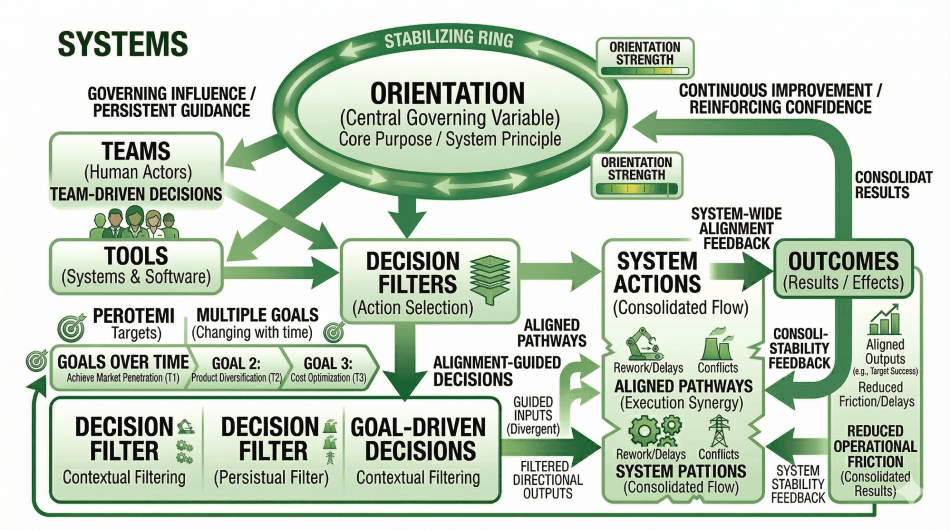
Structural Alignment Starts With Orientation

Systems Layer

In Systems Language, structural alignment occurs when the components of a system respond consistently to the same governing variable.

These components include teams, processes, tools, and decision frameworks. Each element interprets incoming signals and generates actions within its own operational context.

For alignment to emerge, these components must reference a shared orientation.

Orientation establishes the governing variable that determines:

  • which signals the system prioritizes
  • how trade-offs are resolved
  • what outcomes the system attempts to stabilize

When orientation is clearly defined, different parts of the system can operate independently while still producing coherent outcomes. Their decisions are filtered through the same directional constraint.

However, when orientation is unclear, each component begins forming its own interpretation of priority.

Teams develop local goals. Tools are configured differently across departments. Processes evolve to solve local problems rather than system-wide objectives.

The system becomes structurally fragmented.

Structural Translation

In simple terms, alignment does not begin with teams or tools – it begins with direction.

If the system does not clearly define what it is trying to prioritize or protect, every group will fill in that gap differently.

One team may optimize for speed. Another may optimize for accuracy. Another may optimize for cost.

Each group may believe it is supporting the organization’s goals, but without a shared orientation, their efforts do not naturally align.

When direction is clear, coordination becomes much easier. Different teams can work in different ways while still moving toward the same outcome.

Structural Implication

Organizations often attempt to force alignment by adding more coordination mechanisms.

Cross-team meetings increase. Reporting structures expand. Processes become more detailed. Tools are standardized.

These interventions can improve communication, but they cannot fully resolve misalignment if the system’s orientation remains unclear.

Without a shared governing variable, the system continues to produce competing interpretations of priority.

Real alignment occurs when the system first defines its orientation and then allows teams, tools, and processes to organize around that center.

Leverage Insight

Alignment is not created by coordination alone.

It emerges when the system’s components respond to the same governing direction.

Within the five-pillar framework, Orientation establishes the central reference that allows teams, tools, and processes to align structurally rather than through constant coordination.

Instant Digital Access

Secure download link delivered immediately after purchase

Built for Creators

Systems designed to help you build, not just download.

Global Compatibility

Files and toolkits accessible worldwide, no restrictions