
In many organizations, decision making feels inconsistent.
Two teams face similar situations but reach different conclusions. One manager prioritizes speed while another insists on caution. The process may look correct on paper, yet the outcomes vary depending on who is involved.
To solve this, organizations often add more rules or approval layers.
But consistency rarely comes from more rules. It comes from something deeper – a shared reference that decisions can reliably connect to.
This structural pathway is what we can think of as a decision spine.
Systems Layer
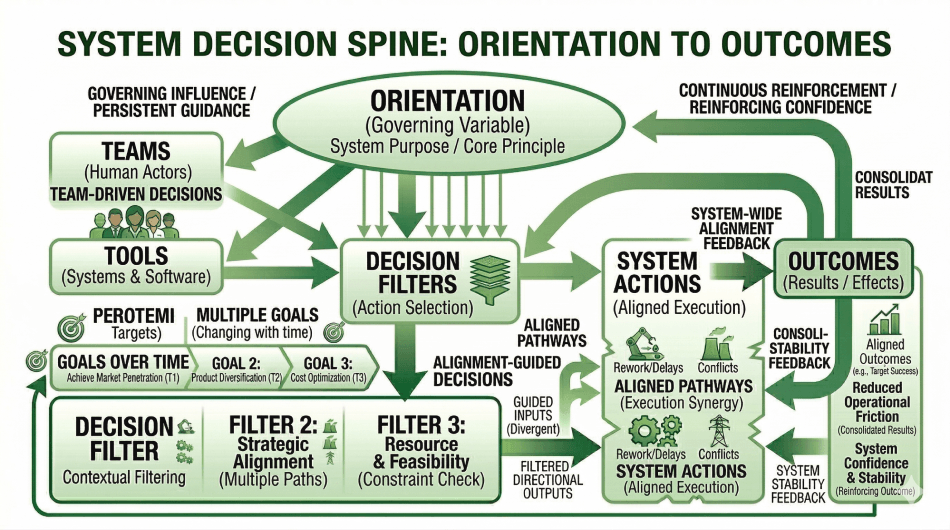
In Systems Language, a decision spine is the structural pathway through which orientation translates into consistent decisions across the system.
Orientation establishes the governing variable that defines what the system prioritizes. However, for this governing variable to influence behavior, it must be connected to the system’s decision mechanisms.

The decision spine performs this role.
It functions as a hierarchical alignment chain that links:
Orientation → Decision Filters → Actions → Outcomes.
When the decision spine is stable, decisions across different contexts reference the same governing variable. This produces coherence even when teams operate independently.
Without a decision spine, orientation remains abstract. Individual decision points interpret priorities differently, producing inconsistent behavior across the system.
The decision spine ensures that the system’s direction is not only defined but structurally embedded into how choices are made.
Structural Translation
In simple terms, a decision spine is the path that connects the system’s direction to everyday decisions.
If orientation answers the question “What matters most?”, the decision spine answers “How do we apply that when making choices?”
When the spine is clear, people can evaluate decisions by asking whether an option supports the system’s orientation.
This allows different teams to make independent decisions while still remaining aligned with the same direction.
Without that connection, orientation becomes a statement rather than a working guide.
Structural Implication
Many organizations define strategic priorities but fail to translate them into consistent decision rules.
As a result, decisions become dependent on individual interpretation. Teams begin solving problems based on local priorities rather than system-wide direction.
This creates visible symptoms such as conflicting initiatives, inconsistent trade-offs, and repeated debates over priorities.
A strong decision spine prevents this fragmentation.
Because orientation is structurally connected to decision filters, choices across the system naturally reference the same governing direction.
Consistency emerges without requiring constant oversight.
Leverage Insight
Direction alone does not stabilize a system.
Direction must be structurally connected to decision-making.
Within the five-pillar framework, Orientation establishes the governing variable, and the decision spine ensures that this orientation consistently guides actions throughout the system.