

Call us toll free: +64 226953063

Instant worldwide digital delivery — no waiting

GRASPLR Help & Support

Direction 10: Competing Orientations Inside Organizations

Sometimes an organization appears coordinated on the surface but behaves inconsistently underneath.

The marketing team pushes for rapid growth. The operations team focuses on reliability. Finance emphasizes cost control. Product teams prioritize innovation.

Each group is making rational decisions based on its own priorities.

Yet across the organization, the results begin to conflict. Projects slow down. Decisions require repeated negotiation. Teams feel like they are pulling in different directions.

This is not necessarily a problem of effort or communication.

Often it is a problem of competing orientations.
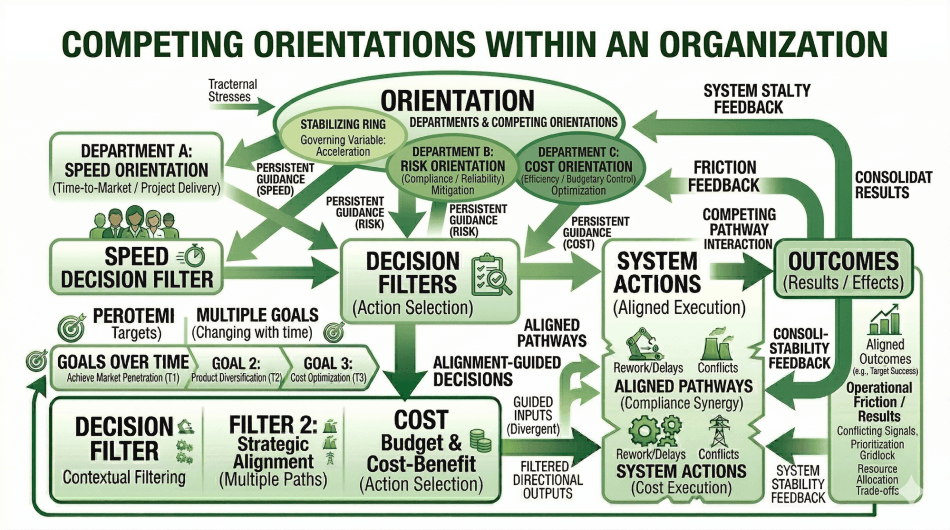
Competing Orientations Inside Organizations

Systems Layer

In Systems Language, competing orientations occur when different parts of a system stabilize around different governing variables.

Orientation determines which signals a system prioritizes and which trade-offs it is willing to make. When the governing variable differs across subsystems, each subsystem interprets situations through a different decision filter.

For example:

  • One subsystem may stabilize around speed.
  • Another may stabilize around risk reduction.
  • Another may stabilize around cost efficiency.

Each orientation generates a consistent internal logic. Within its local context, decisions appear correct and rational.

However, when these subsystems interact, their governing variables conflict.

Because each group is optimizing for a different orientation, the system experiences:

  • conflicting priorities
  • repeated negotiation over trade-offs
  • delayed decisions
  • structural friction between departments

The system is not malfunctioning. It is operating under multiple centers of direction simultaneously.

Structural Translation

In simple terms, different parts of the organization are trying to protect different things.

One team may believe speed matters most. Another may believe safety matters most. Another may believe cost matters most.

Each team builds its decisions around those priorities.

The problem appears when these teams must coordinate. Their decision logic no longer matches.

Instead of moving smoothly, the organization spends time resolving conflicts between priorities that were never aligned in the first place.

Structural Implication

In organizations with competing orientations, coordination costs increase rapidly.

Projects require more meetings. Decisions require more approvals. Strategies shift depending on which department has influence at a given moment.

Leaders often interpret this as a communication or collaboration problem.

But the deeper issue is structural.

If departments operate under different governing variables, no amount of coordination can fully eliminate the friction. Each group continues optimizing for its own orientation.

Sustainable alignment requires establishing a shared system-level orientation that defines how trade-offs should be resolved across departments.

Leverage Insight

Departments naturally optimize for local success.

System alignment occurs only when those local decisions reference a shared governing orientation.

Within the five-pillar framework, Orientation provides the central reference that prevents departments from stabilizing around competing directions.

Instant Digital Access

Secure download link delivered immediately after purchase

Built for Creators

Systems designed to help you build, not just download.

Global Compatibility

Files and toolkits accessible worldwide, no restrictions