
Systems rarely lose direction all at once.
More often, the change is gradual. At first, the differences are small. A few decisions feel slightly inconsistent. Teams begin interpreting priorities differently in certain situations. Projects that once moved smoothly start requiring more clarification.
Nothing appears dramatically wrong.
But over time, these small deviations accumulate. Decisions become harder to coordinate. Outcomes feel less predictable. The system begins to feel like it is working harder while producing less coherent results.
These are often the early signals of orientation drift.
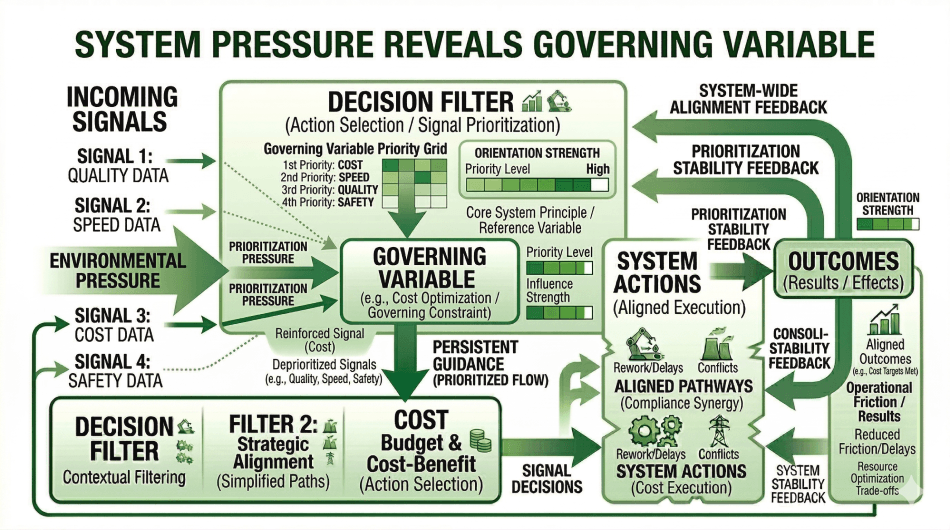
Systems Layer
In Systems Language, orientation drift occurs when the governing variable that stabilizes a system begins to weaken or fragment.
A system maintains alignment when its governing variable consistently filters incoming signals and resolves trade-offs. This creates stable decision patterns across different parts of the system.

Drift begins when this governing variable no longer acts as the dominant reference condition.
Several structural conditions can produce this effect:
- Signal competition increases. New priorities, pressures, or incentives begin competing with the original governing variable.
- Decision filters diverge. Different parts of the system interpret the governing variable in slightly different ways.
- Feedback loops weaken. Outcomes that once reinforced the governing variable stop clearly signaling alignment.
As these conditions accumulate, the system slowly shifts from a single stable orientation to multiple partial orientations.
The system continues operating, but its internal coherence gradually erodes.
Structural Translation
In simple terms, orientation drift begins when people stop making decisions according to the same underlying priority.
At first, the differences are subtle.
One team begins making trade-offs that would previously have been rejected. Another team interprets priorities slightly differently. Meetings spend more time debating what matters most.
None of these signals appear critical on their own.
But together, they indicate that the system’s shared direction is weakening.
Structural Implication
Orientation drift often goes unnoticed because operational performance may remain acceptable for some time.
Teams compensate by increasing coordination, adding oversight, or clarifying decisions case by case. These adjustments can temporarily mask the underlying structural shift.
However, as drift continues, coordination costs rise.
Decisions require more discussion. Strategies feel less stable. Different parts of the system begin optimizing for different priorities.
If the drift continues unchecked, the system may eventually behave as though it has multiple competing orientations, creating persistent misalignment across departments.
Early detection allows the system to restore its governing variable before fragmentation becomes entrenched.
Leverage Insight
Systems rarely lose direction suddenly.
They drift gradually as the governing variable loses its influence over decisions.
Within the five-pillar framework, Orientation must be periodically revalidated to ensure the system continues stabilizing around the same governing direction.