

Call us toll free: +64 226953063

Instant worldwide digital delivery — no waiting

GRASPLR Help & Support

Direction 13: The Role of Constraints in Orientation

At first glance, constraints seem like obstacles.

Budgets limit what can be built. Time restricts how much can be done. Policies reduce flexibility. Teams often feel that removing constraints would allow the system to move faster and achieve more.

But in practice, systems without constraints rarely become more effective.

Instead, they tend to expand in multiple directions at once. New initiatives appear, priorities multiply, and resources spread across too many activities.

What initially looks like freedom often becomes loss of direction.
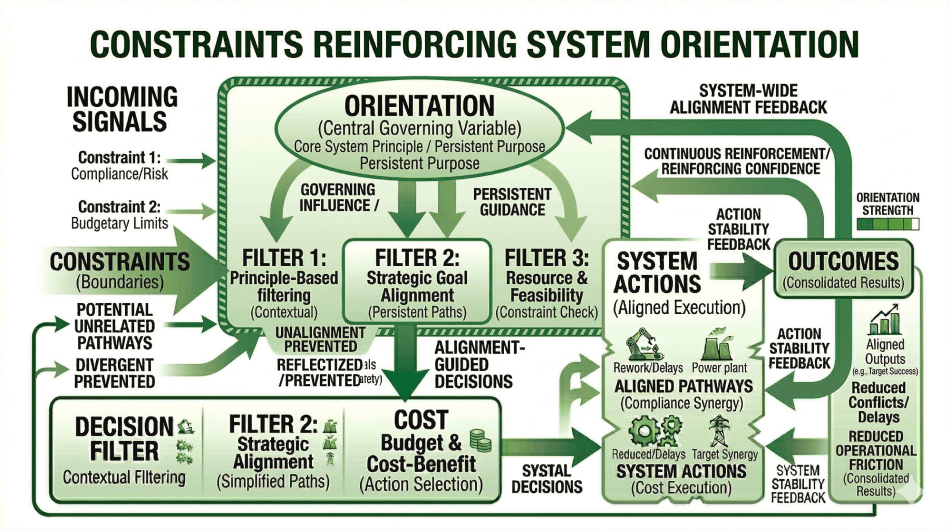
The Role of Constraints in Orientation

Systems Layer

In Systems Language, constraints act as structural boundaries that reinforce a system’s orientation.

Orientation defines the governing variable that determines what the system prioritizes. However, without constraints, the system may still attempt to pursue too many signals simultaneously.

Constraints limit the range of acceptable system behavior.

They function as directional stabilizers by restricting actions that do not support the governing variable. By narrowing the decision space, constraints make it easier for the system to consistently prioritize its orientation.

Three structural effects occur when constraints reinforce orientation:

  1. Signal filtering becomes stronger.
    Signals that conflict with the governing variable are more easily rejected.
  2. Decision pathways become clearer.
    Teams spend less time evaluating options that fall outside the system’s direction.
  3. Feedback loops strengthen alignment.
    Actions repeatedly reinforce the same orientation because alternative pathways are structurally limited.

Without constraints, the system remains technically capable of moving in many directions, weakening the stabilizing influence of orientation.

Structural Translation

In simple terms, constraints help a system stay focused.

If a team tries to pursue every opportunity, priorities quickly become scattered. Even with a clear direction, the system may drift because nothing prevents it from expanding into unrelated areas.

Constraints solve this by setting boundaries.

They answer questions such as:

  • What will we not do?
  • Which opportunities fall outside our direction?
  • Which trade-offs will we refuse to make?

By limiting options, constraints protect the system’s orientation.

Structural Implication

Organizations often attempt to remove constraints in the name of flexibility or growth.

But removing too many constraints can weaken the system’s directional stability.

Teams begin exploring unrelated opportunities. Projects accumulate beyond the system’s capacity. Strategic focus becomes diluted.

The result is not greater capability – it is uncontrolled expansion.

Strong systems intentionally design constraints that protect their orientation. These constraints prevent the system from dispersing its energy across too many directions.

Instead of restricting progress, they preserve coherence.

Leverage Insight

Constraints do not limit a system’s direction.

They protect it.

Within the five-pillar framework, Orientation establishes the direction, and constraints stabilize the system by preventing expansion into paths that weaken that direction.

Instant Digital Access

Secure download link delivered immediately after purchase

Built for Creators

Systems designed to help you build, not just download.

Global Compatibility

Files and toolkits accessible worldwide, no restrictions