
Complex environments create difficult decisions.
Organizations face competing priorities: speed versus quality, growth versus stability, innovation versus reliability. Each option may appear valuable, and choosing between them can feel complicated.
To manage this complexity, teams often introduce more analysis, more meetings, and more approval layers. The intention is to make better decisions by considering more information.
Yet in many cases, the real challenge is not a lack of information.
It is a lack of clear direction.
When the system’s orientation is well defined, many decisions that once felt complex become much easier to resolve.
Systems Layer
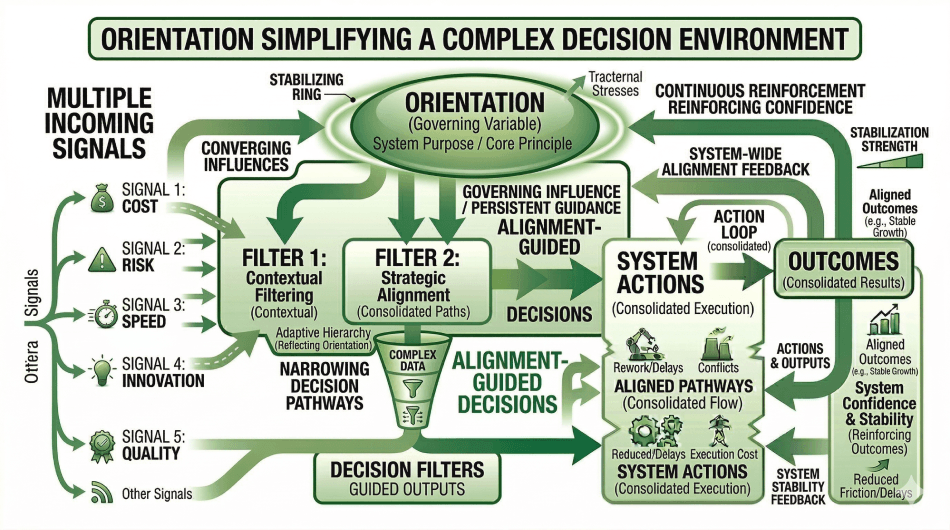
In Systems Language, orientation simplifies decision environments by acting as a dominant signal that organizes competing inputs.
Complex systems constantly receive signals from multiple sources: customer needs, operational constraints, financial pressures, regulatory requirements, and technological possibilities.

Without a governing variable, these signals compete equally within the decision process. The system must repeatedly negotiate trade-offs because no signal has a structural priority over the others.
Orientation resolves this competition.
By defining the governing variable, orientation establishes a priority rule that filters incoming signals before they enter the decision process. Signals that reinforce the governing variable gain influence, while signals that conflict with it lose influence.
This reduces the number of viable decision pathways the system must consider.
Instead of evaluating every possible option, the system evaluates only those consistent with its orientation.
The result is a simplified decision landscape.
Structural Translation
In simple terms, clear direction reduces the number of decisions that need to be debated.
When people understand what the system prioritizes, they can quickly eliminate options that move in the wrong direction.
For example:
- If the system prioritizes safety, risky shortcuts are rejected early.
- If the system prioritizes speed, overly complex processes are avoided.
- If the system prioritizes long-term value, short-term gains that undermine sustainability are filtered out.
Instead of debating every option equally, the system uses orientation as a guide to narrow the choices.
This makes decision-making faster and more consistent.
Structural Implication
Organizations often attempt to manage complexity by expanding analysis or governance structures.
While these tools can help, they rarely solve the underlying issue if the system’s orientation remains unclear.
Without a clear governing variable, each decision must be negotiated from scratch. Teams debate priorities repeatedly because the system has no shared rule for resolving trade-offs.
This creates decision fatigue, slower progress, and strategic inconsistency.
When orientation is clear, however, many of these debates disappear. The system already knows which direction decisions should support.
Complex environments remain complex, but the decision pathway becomes clearer.
Leverage Insight
Clarity does not come from reducing complexity.
It comes from establishing a governing direction that organizes complexity.
Within the five-pillar framework, Orientation simplifies decision environments by filtering signals and aligning choices with a shared strategic direction.