
In many organizations, friction between teams feels unavoidable.
Product wants to move quickly. Operations wants stability. Finance emphasizes cost discipline. Customer support pushes for reliability. Each team sees the system from a different angle, and coordination often becomes a negotiation.
Meetings multiply. Decisions take longer. Teams feel like they are constantly resolving misunderstandings.
This friction is often treated as a communication problem.
But frequently, the deeper issue is simpler: the teams are not working from the same direction.
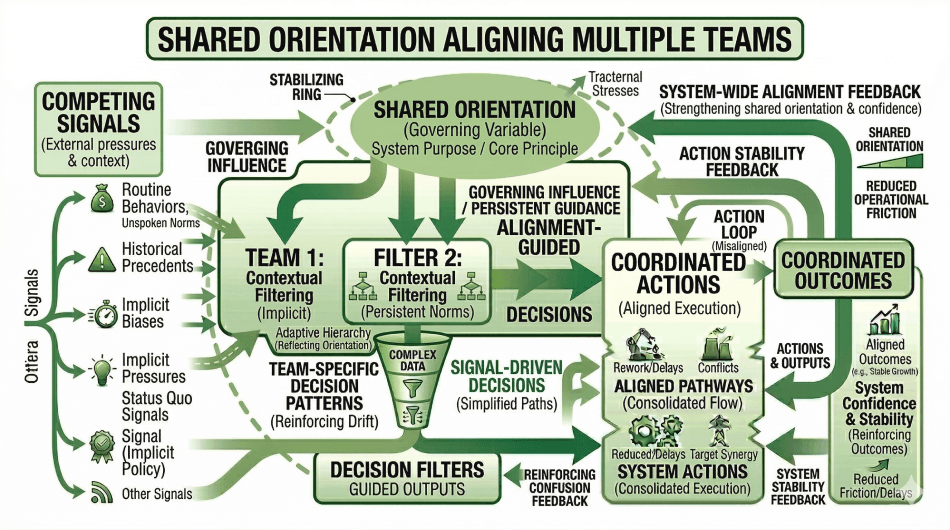
Systems Layer
In Systems Language, alignment emerges when multiple subsystems reference the same governing variable.
Each team within an organization operates as a subsystem. It receives signals, interprets priorities, and generates actions within its own domain.

Without a shared orientation, each subsystem naturally stabilizes around its own governing variable:
- Product may prioritize innovation.
- Operations may prioritize reliability.
- Finance may prioritize cost control.
- Sales may prioritize growth.
Each subsystem behaves rationally within its local environment. However, when these subsystems interact, their decision filters produce conflicting actions.
Shared orientation resolves this structural conflict.
When a system establishes a clear governing variable, every subsystem interprets incoming signals through the same directional constraint. Local decisions may still differ in method, but they align in purpose.
This reduces the structural tension between teams.
Structural Translation
In simple terms, shared direction allows different teams to make different decisions without pulling against each other.
Teams do not need to operate identically. Product may still innovate, operations may still manage reliability, and finance may still monitor costs.
But when everyone understands what the organization ultimately prioritizes, those decisions naturally align.
Instead of debating which team is “right,” the conversation becomes:
Which option best supports our shared direction?
That shared reference removes much of the friction between roles.
Structural Implication
Organizations often attempt to solve alignment problems by increasing coordination.
More cross-team meetings are scheduled. Communication channels expand. Processes are introduced to ensure collaboration.
While these efforts help, they cannot fully eliminate friction if teams operate under different orientations.
Without a shared governing variable, each department continues optimizing its own priorities. Coordination becomes a constant negotiation between competing directions.
When orientation is clear and shared, alignment becomes easier. Teams no longer need to resolve every disagreement through negotiation because the system already defines how trade-offs should be resolved.
Leverage Insight
Teams align naturally when they share the same governing direction.
Within the five-pillar framework, Orientation reduces structural friction by giving every subsystem the same reference point for decision-making.