
Many teams feel overwhelmed by the number of decisions they must make.
Every day brings new requests, opportunities, trade-offs, and problems. Should the team pursue this idea? Adjust this process? Respond to this signal? Evaluate this opportunity?
Without a clear way to prioritize, each situation becomes a separate discussion. Meetings expand, analysis grows, and decision fatigue begins to accumulate.
The challenge is often not the number of signals entering the system.
It is the absence of a filter that quickly determines which signals deserve attention.
Systems Layer
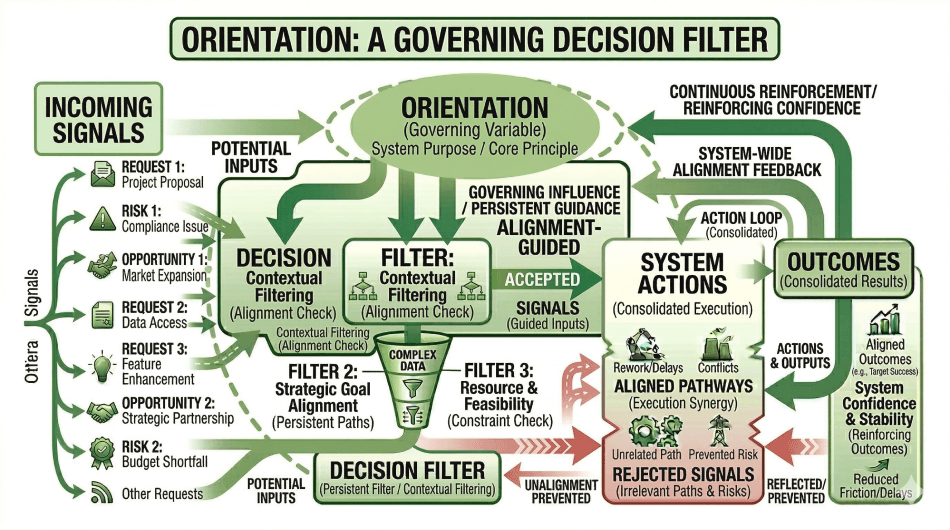
In Systems Language, orientation functions as a decision filter that reduces the cognitive load of the system.
Systems constantly receive signals from their environment: opportunities, risks, requests, and constraints. Each signal has the potential to trigger evaluation and action.

However, processing every signal equally would exceed the system’s decision capacity.
Orientation solves this problem by acting as a pre-filtering mechanism.
The governing variable established by orientation determines which signals are relevant to the system’s direction and which signals fall outside its priority structure.
When a signal enters the system, it is evaluated against the governing variable:
- Signals consistent with orientation move forward into deeper decision processes.
- Signals inconsistent with orientation are filtered out early.
This dramatically reduces the number of decisions the system must actively process.
Instead of debating every possibility, the system focuses only on options that reinforce its direction.
Structural Translation
In simple terms, orientation answers many decisions before they even need to be discussed.
If a team clearly understands what the system prioritizes, it can quickly reject options that move in the wrong direction.
For example:
- If the organization prioritizes long-term reliability, risky shortcuts are dismissed quickly.
- If the system prioritizes speed and iteration, overly complex solutions are avoided early.
- If the orientation prioritizes customer trust, decisions that compromise transparency are filtered out.
By eliminating options that conflict with the system’s direction, orientation reduces the number of choices that require serious evaluation.
Structural Implication
Organizations without a strong orientation experience higher cognitive load.
Every request must be analyzed. Every opportunity must be debated. Teams must repeatedly negotiate priorities because no structural rule determines which signals matter most.
This creates slower decision cycles and decision fatigue across the system.
When orientation acts as a strong decision filter, the system processes far fewer signals. Teams spend less time debating options that were never aligned with the system’s direction.
Decision energy becomes concentrated on choices that truly matter.
Leverage Insight
Strong systems do not make more decisions.
They eliminate unnecessary ones.
Within the five-pillar framework, Orientation reduces cognitive load by filtering signals before they enter the decision process, allowing the system to focus its attention on choices that reinforce its direction.