

Call us toll free: +64 226953063

Instant worldwide digital delivery — no waiting

GRASPLR Help & Support

Direction 25: The Center That Holds the System Together

Across organizations, teams, and even personal workflows, systems often struggle with the same underlying problem.

Processes become more complex. Tools multiply. Teams expand. Metrics increase. Yet despite all of these improvements, something still feels unstable.

Decisions become harder to coordinate. Priorities shift unexpectedly. Effort increases while alignment slowly weakens.

When this happens, the issue is rarely the outer structure of the system.

More often, the system has lost sight of its center.
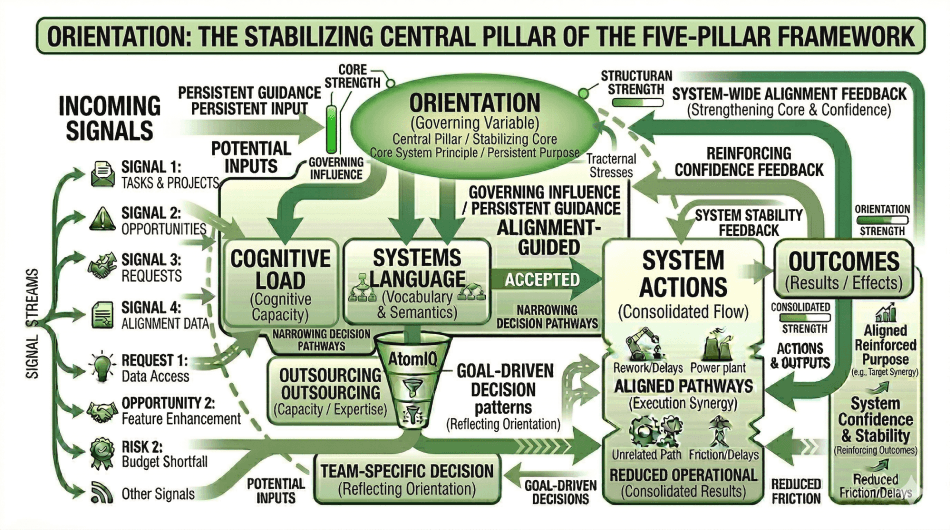
The Center That Holds the System Together

Systems Layer

In Systems Language, orientation functions as the stabilizing center that allows the rest of the system architecture to operate coherently.

Within the five-pillar framework, the outer pillars represent capabilities that expand what the system can do:
  • Cognitive Load determines how much complexity the system can process.
  • Systems Language determines how clearly the system can perceive and describe its structure.
  • Outsourcing distributes work across external tools, processes, and collaborators.
  • AtomIQ creates leverage by turning knowledge and effort into scalable components.

Each pillar increases the system’s capability.

However, without a stable orientation, these capabilities do not automatically align. Increased capacity can actually amplify fragmentation if the system does not share a common direction.

Orientation solves this structural problem.

It establishes the governing variable that organizes how all other capabilities are applied. Cognitive capacity is focused toward the same direction. Systems language interprets signals relative to the same priority. Outsourced components operate within the same constraints. Atomized leverage compounds toward the same outcome.

Orientation does not add capability.

It organizes capability.

Structural Translation

In simple terms, orientation answers the question that all systems must eventually resolve:

What direction should all of this capability serve?

Teams can become more capable. Tools can become more powerful. Processes can become more efficient.

But if the system does not share a clear direction, those improvements may push the system in multiple directions at once.

When orientation is clear, however, everything becomes easier to coordinate.

The system’s capacity, language, tools, and leverage mechanisms all reinforce the same direction.

Instead of competing with each other, they begin to compound.

Structural Implication

Organizations often focus heavily on improving the outer capabilities of their system.

They invest in better tools, stronger processes, more sophisticated metrics, and increased operational capacity.

These improvements are valuable. But when orientation is unclear, they can unintentionally increase complexity rather than coherence.

More capability means more possible directions.

Without a stabilizing center, the system must constantly negotiate priorities across expanding possibilities.

When orientation becomes clear and stable, those same capabilities become powerful.

Instead of amplifying confusion, they amplify direction.

Leverage Insight

A system does not become coherent by adding more capability.

It becomes coherent when its capabilities share a common center.

Within the five-pillar framework, Orientation is the stabilizing center that allows Cognitive Load, Systems Language, Outsourcing, and AtomIQ to function as reinforcing forces rather than competing ones.

Instant Digital Access

Secure download link delivered immediately after purchase

Built for Creators

Systems designed to help you build, not just download.

Global Compatibility

Files and toolkits accessible worldwide, no restrictions