
Have you ever watched a project fail and noticed how quickly people start looking for someone to blame?
Maybe the team says the manager made a bad decision. The manager says the team lacked initiative. Leadership says the strategy wasn’t executed properly.
Everyone points to individuals. Yet the same kinds of problems keep repeating.
At some point you begin to suspect something else is going on — something deeper than personalities or intentions.
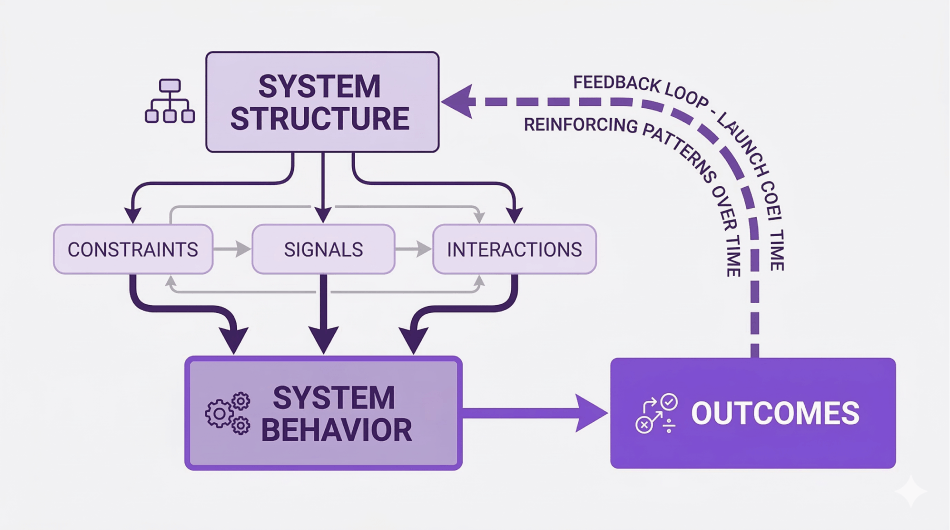
Systems Layer
Systems Language is a way of describing outcomes as the result of structures, constraints, and interactions within a system.
Instead of focusing on individual behavior, Systems Language focuses on:

- Structures — how components are arranged
- Constraints — the limits placed on actions or decisions
- Signals — the information flowing through the system
- Interactions — how components influence each other over time
Within complex environments, outcomes emerge from how these elements interact.
The system’s structure shapes what behaviors are easy, difficult, or nearly impossible.
When people operate within the same structure, similar outcomes tend to repeat regardless of who occupies the roles inside it.
Systems Language therefore shifts the focus of explanation from who did what to how the system produced the result.
Structural Translation
In simple terms, Systems Language is a way of explaining how the setup of a situation creates the outcome.
Instead of asking:
“Who made the mistake?”
Systems Language asks:
“What in the system made this result likely?”
For example, if a team constantly misses deadlines, the explanation might not be poor discipline. The system might contain:
- unclear priorities
- conflicting signals from leadership
- overloaded decision channels
- missing coordination mechanisms
People inside the system are reacting to these conditions.
The structure shapes the behavior.
Structural Implication
When systems are explained only through personalities or intentions, the underlying structures remain invisible.
This leads to recurring problems:
- organizations repeatedly reorganize people rather than redesign systems
- teams attempt to solve structural issues with motivation or discipline
- leaders misdiagnose systemic patterns as individual failures
Because the structure does not change, the same patterns return.
Different people enter the system, but the outcomes remain familiar.
Leverage Insight
Systems Language increases perception.
It allows people to see the structures that produce outcomes rather than focusing only on the visible actions of individuals.
This shift in perception creates the possibility of structural leverage — changing the system instead of repeatedly correcting the people inside it.
Pillar: Systems Language — perception.