

Call us toll free: +64 226953063

Instant worldwide digital delivery — no waiting

GRASPLR Help & Support

Perception 2: Seeing Structure Instead of Stories

When something goes wrong in a team or organization, the explanation usually appears quickly.

Someone tells a story about what happened.

Maybe the story is that a manager made a poor decision. Maybe a team member lacked initiative. Maybe leadership failed to communicate clearly. The story connects actions and personalities into a sequence that seems to explain the outcome.

Stories are natural. They help people make sense of events.

But stories often describe what happened, not why the system produced that result.
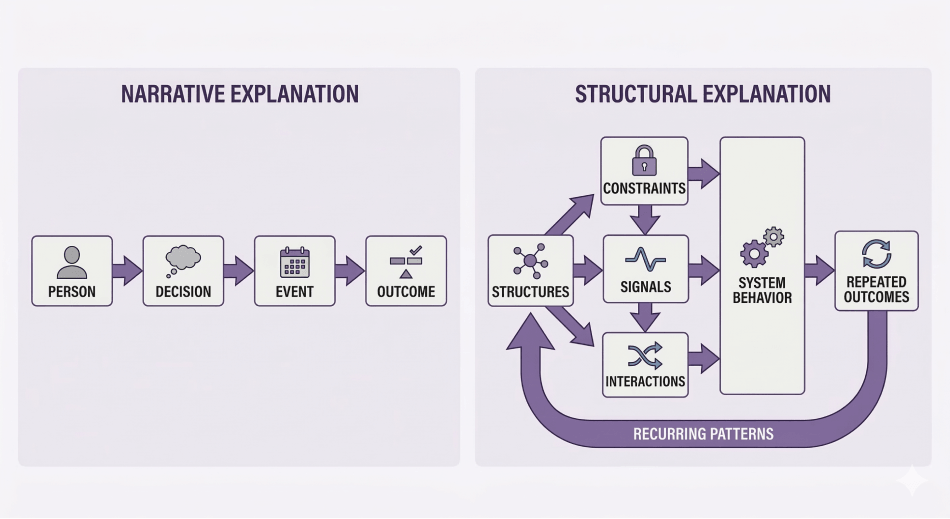
Seeing Structure Instead of Stories

Systems Layer

Human interpretation tends to default to narrative reasoning.

Narratives organize events into sequences involving actors, intentions, and decisions. They emphasize:

  • individual behavior
  • moments of choice
  • visible actions
  • linear cause-and-effect explanations

Systems thinking uses a different explanatory frame.

Instead of narratives, it searches for underlying structure.

Structural analysis focuses on:

  • system arrangements — how components are organized
  • constraints — what limits or channels behavior
  • signal flows — what information is visible or hidden
  • interaction patterns — how components influence each other over time

From a systems perspective, recurring outcomes are rarely explained by a single decision or individual action.

They are produced by structural conditions that make certain behaviors predictable.

Stories describe events.
Structures generate patterns.

Structural Translation

In simple terms, most people explain events by telling stories about people.

Systems thinkers try to identify the setup that made the event likely.

For example:

A project might fail and the story becomes:

“Leadership made the wrong call.”

A structural explanation might instead ask:

  • Were priorities competing?
  • Were decision rights unclear?
  • Was information delayed or incomplete?
  • Were teams dependent on each other without coordination mechanisms?

These conditions shape what people inside the system can realistically do.

What looks like a single mistake may actually be the visible expression of a deeper structural pattern.

Structural Implication

When organizations rely only on narrative explanations, they often intervene at the wrong level.

Common responses include:

  • replacing individuals
  • issuing new rules or reminders
  • asking people to try harder
  • increasing oversight

These actions address the story, not the structure.

Because the system itself remains unchanged, the same patterns reappear.

Different people enter the system, but the structural conditions continue producing similar outcomes.

Leverage Insight

Narratives explain events.

Systems Language explains patterns.

Learning to see structure instead of stories increases the ability to diagnose why outcomes repeat — and where structural leverage actually exists.

Pillar: Systems Language — perception.

Instant Digital Access

Secure download link delivered immediately after purchase

Built for Creators

Systems designed to help you build, not just download.

Global Compatibility

Files and toolkits accessible worldwide, no restrictions