

Call us toll free: +64 226953063

Instant worldwide digital delivery — no waiting

GRASPLR Help & Support

Perception 4: The Difference Between Events and Systems

Most discussions about problems begin with a specific moment.

A deadline was missed.
A project stalled.
A decision created unexpected consequences.

People immediately analyze the event itself. They replay what happened, who was involved, and what should have been done differently.

This kind of analysis feels practical because events are visible and concrete.

But focusing only on events often leaves a deeper question unexplored.

Why did the system produce that event in the first place?
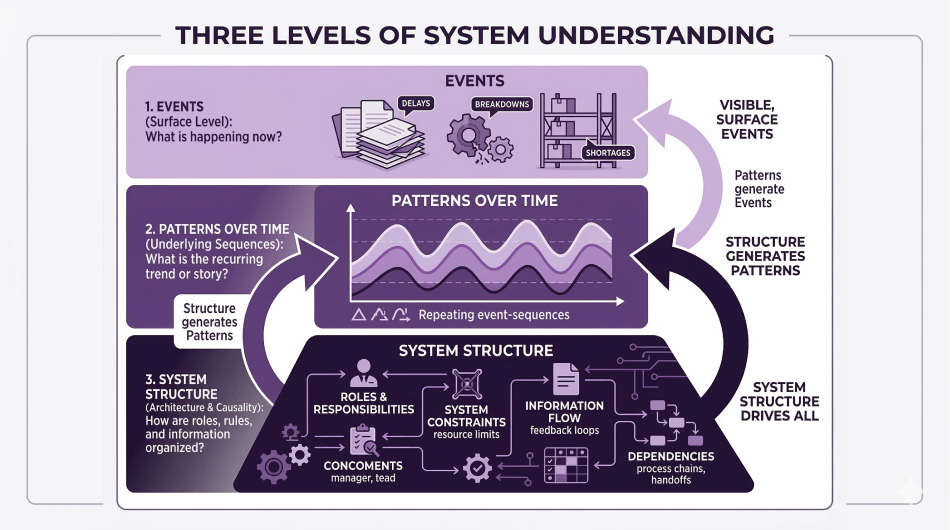
The Difference Between Events and Systems

Systems Layer

In complex environments, events are surface-level expressions of deeper system dynamics.

Systems operate across multiple levels:

  1. Events — observable moments or outcomes
  2. Patterns — recurring sequences of events over time
  3. Structures — underlying arrangements, constraints, and interactions that generate those patterns

Events are the most visible layer, but they provide the least structural information.

The deeper explanatory power lies in system structure, which includes:

  • how roles and responsibilities are arranged
  • how information moves through the system
  • what constraints limit decisions
  • how different components depend on each other

These structural elements shape the patterns that eventually produce observable events.

When attention remains focused only on events, the structural drivers of system behavior remain hidden.

Structural Translation

In simple terms, events are what we see, while systems are what produces what we see.

For example, a team missing a deadline is an event.

But if missed deadlines happen repeatedly, that suggests a pattern.

When we investigate the pattern, we may find structural causes such as:

  • unclear ownership of tasks
  • overloaded decision bottlenecks
  • poor coordination between teams
  • delayed information flow

The event itself is just the final visible outcome of these underlying conditions.

Looking only at the event is like trying to understand a river by studying a single wave.

Structural Implication

When organizations focus only on events, they tend to respond with short-term corrections.

Common responses include:

  • emergency meetings
  • temporary fixes
  • reminders or warnings
  • reactive policy changes

These actions address the immediate event but leave the underlying structure untouched.

As a result, the same kinds of events often reappear later.

Without structural analysis, organizations can become trapped in cycles of reacting to problems rather than redesigning the systems that produce them.

Leverage Insight

Events attract attention because they are visible.

But leverage usually exists at the level of structure.

Systems Language shifts analysis away from isolated events and toward the structural conditions that generate patterns over time.

Seeing this distinction is a key step in understanding complex environments.

Pillar: Systems Language — perception.

Instant Digital Access

Secure download link delivered immediately after purchase

Built for Creators

Systems designed to help you build, not just download.

Global Compatibility

Files and toolkits accessible worldwide, no restrictions