

Call us toll free: +64 226953063

Instant worldwide digital delivery — no waiting

GRASPLR Help & Support

Perception 7: Interactions – Where Systems Actually Live

When people try to understand a system, they often begin by listing its parts.

A team includes managers, staff, tools, and processes. A project includes milestones, tasks, and resources. An organization includes departments, roles, and policies.

At first, this seems like a reasonable way to describe the system.

But something important is missing.

Two organizations can have nearly identical components and still behave very differently. The difference often lies not in the parts themselves, but in how those parts interact.
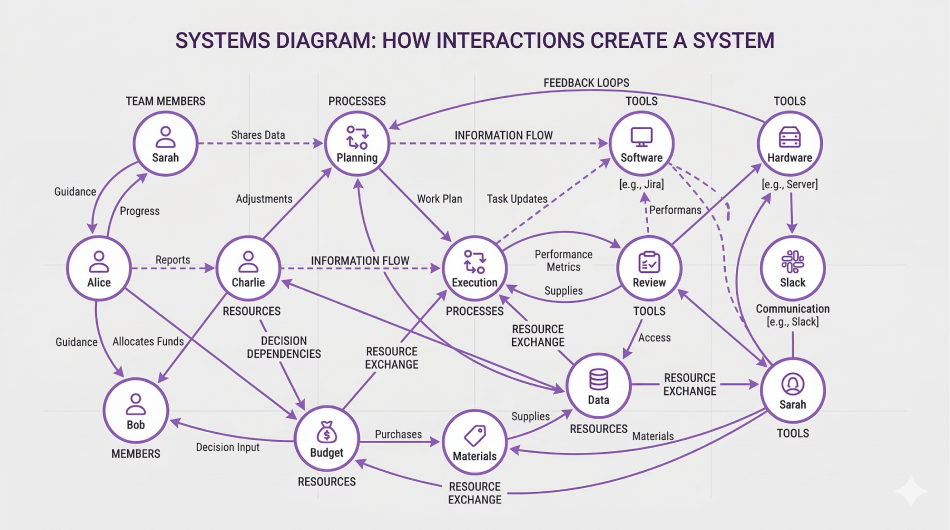
Interactions: Where Systems Actually Live

Systems Layer

In systems thinking, the defining characteristic of a system is not simply the presence of components, but the relationships between them.

A system emerges when components are connected through interactions that influence one another over time.

These interactions may include:

  • information flows between actors or processes
  • resource exchanges such as time, attention, or materials
  • decision dependencies where one component relies on another
  • feedback loops where outputs from one part influence future behavior in another

Through these relationships, components become interdependent.

The behavior of the system arises from the pattern of interactions rather than from any single component in isolation

If the components remain the same but the interactions change, the system’s behavior can change dramatically.

In this sense, systems “live” in the network of relationships connecting their parts.

Structural Translation

In simple terms, a system is not just a collection of things.

It is a network of connections between things.

Imagine two teams with the same structure and number of people.

In one team:

  • information moves quickly
  • decisions flow clearly
  • coordination happens smoothly

In the other team:

  • communication is delayed
  • responsibilities overlap
  • decisions require multiple approvals

The people may be similar, but the interaction patterns are different.

Those interaction patterns shape how the system behaves.

Structural Implication

When organizations analyze systems only by looking at components, they often overlook the relationships that actually drive behavior.

Common mistakes include:

  • restructuring teams without improving communication pathways
  • adding new tools without adjusting how information flows
  • assigning responsibilities without clarifying dependencies
  • increasing resources without improving coordination

These interventions focus on parts of the system while leaving the interaction structure unchanged.

As a result, many system behaviors persist even after visible components are modified.

Leverage Insight

Components define what a system contains.

Interactions define how the system behaves.

Systems Language helps reveal these interaction patterns, allowing leaders and teams to focus on the relationships that generate outcomes rather than only the visible parts of the system.

Pillar: Systems Language — perception.

Instant Digital Access

Secure download link delivered immediately after purchase

Built for Creators

Systems designed to help you build, not just download.

Global Compatibility

Files and toolkits accessible worldwide, no restrictions