

Call us toll free: +64 226953063

Instant worldwide digital delivery — no waiting

GRASPLR Help & Support

Perception 8: Feedback Loops – The Engines of System Behavior

Sometimes a situation seems to accelerate on its own.

A successful product attracts more users, which increases visibility, which attracts even more users. Growth begins slowly but then quickly compounds.

In other situations, the opposite happens. When something moves too far in one direction, forces appear that pull it back. A team working excessive hours eventually slows down due to fatigue, restoring a more sustainable pace.

These patterns often feel mysterious because no single decision appears to be controlling them.

What is actually happening is the influence of feedback loops within the system.
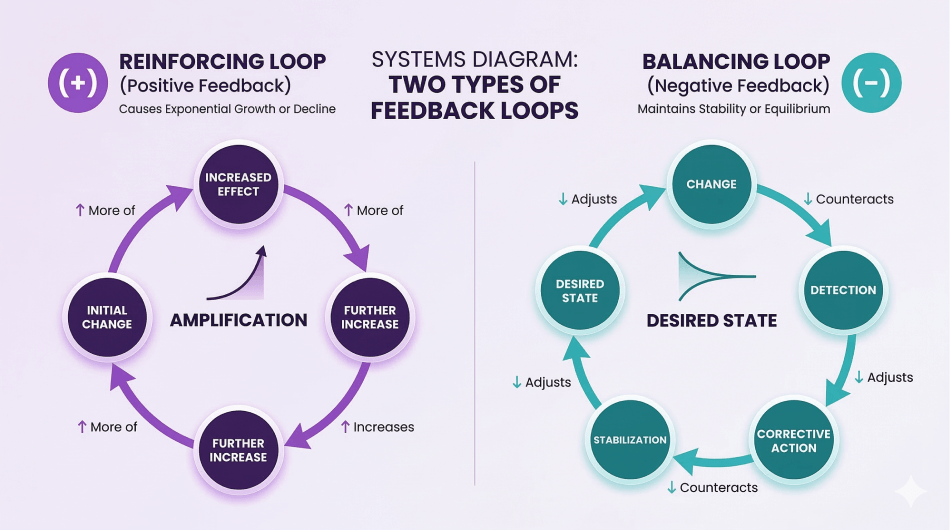
Feedback Loops: The Engines of System Behavior

Systems Layer

A feedback loop occurs when the output of a system influences future behavior within the same system.

In other words, the system’s results feed back into the conditions that shape its next actions.

There are two fundamental types of feedback loops:

Reinforcing Loops

Reinforcing loops amplify change.

In a reinforcing loop, an initial effect increases the conditions that produce more of the same effect.

Structure:

Change → Effect → More Change

Examples include:

  • network growth in social platforms
  • reputation increasing opportunities
  • compound learning or skill development

Reinforcing loops generate acceleration, growth, or escalation within systems.

Balancing Loops

Balancing loops stabilize systems.

In a balancing loop, changes trigger responses that counteract the change and push the system toward equilibrium.

Structure:

Change → Counteracting Response → Stabilization

Examples include:

  • thermostats regulating temperature
  • budget controls limiting spending
  • fatigue slowing excessive workloads

Balancing loops generate stability, regulation, and limits within systems.

Structural Translation

In simple terms, feedback loops explain why systems sometimes speed up and sometimes settle down.

A reinforcing loop is like a snowball rolling downhill — each turn makes it larger and faster.

A balancing loop is like a thermostat — when temperature rises too high, the system activates a correction to bring it back.

Most real systems contain multiple loops interacting at once.

Reinforcing loops drive growth or escalation.
Balancing loops prevent systems from moving too far in one direction.

The overall behavior of a system emerges from how these loops interact.

Structural Implication

Without recognizing feedback loops, system behavior can appear unpredictable.

Organizations often misinterpret feedback-driven patterns as isolated events.

Examples include:

  • mistaking reinforcing growth for permanent success
  • ignoring balancing limits until they suddenly slow progress
  • applying short-term fixes that unintentionally strengthen negative reinforcing loops

Because feedback loops operate continuously, small structural changes can produce large long-term effects.

Understanding these loops allows organizations to anticipate how systems evolve over time.

Leverage Insight

Feedback loops are the engines of system behavior.

Reinforcing loops create momentum.
Balancing loops create stability.

Systems Language reveals these loops, allowing leaders and designers to understand where growth will compound and where limits will eventually appear.

Pillar: Systems Language — perception.

Instant Digital Access

Secure download link delivered immediately after purchase

Built for Creators

Systems designed to help you build, not just download.

Global Compatibility

Files and toolkits accessible worldwide, no restrictions