

Call us toll free: +64 226953063

Instant worldwide digital delivery — no waiting

GRASPLR Help & Support

Perception 11: Signal Versus Noise in Complex Systems

In complex environments, information is everywhere.

Dashboards update constantly. Messages arrive from multiple channels. Meetings generate new priorities. Reports circulate through teams and departments.

Despite the abundance of information, clarity often remains difficult to achieve.

Important developments can be missed while attention is consumed by minor issues. Teams react to immediate problems while larger structural shifts go unnoticed.

The challenge is not simply a lack of information.

The challenge is distinguishing signal from noise.
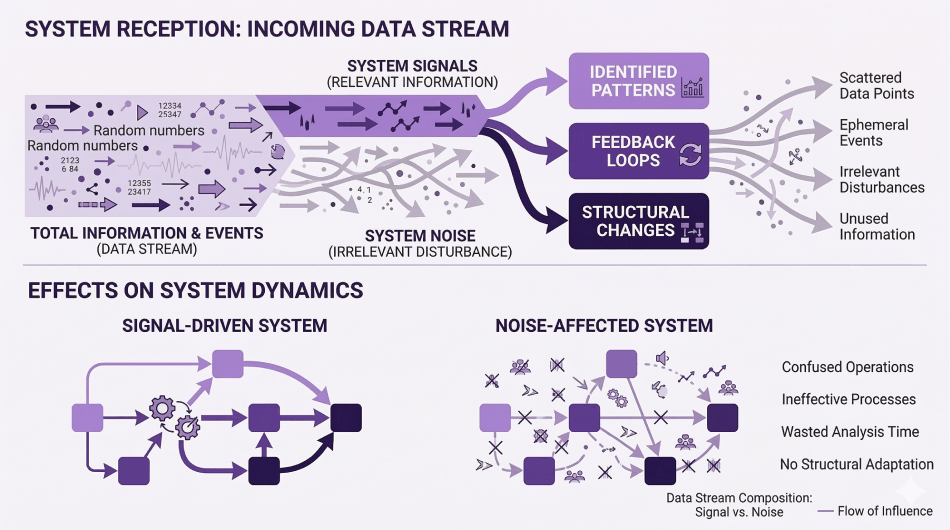
Signal Versus Noise in Complex Systems

Systems Layer

In complex systems, signals are pieces of information that reveal something meaningful about the system’s structure or behavior.

Noise, by contrast, consists of background activity that does not significantly alter the system’s dynamics.

Signals typically appear as:

  • persistent patterns rather than isolated events
  • changes in system relationships or interaction flows
  • feedback effects that influence future system behavior
  • structural shifts in constraints, incentives, or information flows

Noise, on the other hand, often includes:

  • temporary fluctuations
  • isolated incidents
  • short-lived anomalies
  • activity that does not alter the system’s structure

Because complex systems generate large amounts of activity, signals are often embedded within layers of noise.

Systems Language helps filter this complexity by directing attention toward structural patterns rather than individual events.

Structural Translation

In simple terms, signal is the information that tells you how the system actually works.

Noise is the activity that surrounds the system but does not meaningfully change its behavior.

For example, a single missed deadline may be noise if it happens occasionally.

But repeated delays across multiple projects may signal a structural issue such as overloaded decision channels or unclear priorities.

Similarly, a sudden spike in demand may be noise.

But a consistent upward trend may signal a reinforcing feedback loop in the system.

Systems Language encourages observers to look beyond isolated moments and focus on patterns and structural relationships.

Structural Implication

When organizations struggle to distinguish signal from noise, attention becomes scattered.

Common outcomes include:

  • reacting to short-term fluctuations while ignoring long-term trends
  • making decisions based on isolated events
  • constantly shifting priorities in response to temporary issues
  • overlooking structural patterns that shape outcomes over time

This creates environments where activity increases but understanding does not.

Systems analysis improves clarity by asking a deeper question:

Does this information reveal something about the system’s structure or behavior pattern?

If not, it may simply be noise.

Leverage Insight

Complex systems produce large volumes of activity.

Systems Language helps filter this activity by focusing on patterns, structures, and feedback relationships.

By distinguishing signal from noise, observers can direct attention toward the information that actually explains system behavior.

Pillar: Systems Language — perception.

Instant Digital Access

Secure download link delivered immediately after purchase

Built for Creators

Systems designed to help you build, not just download.

Global Compatibility

Files and toolkits accessible worldwide, no restrictions