

Call us toll free: +64 226953063

Instant worldwide digital delivery — no waiting

GRASPLR Help & Support

Perception 12: System Pressure Points

Sometimes a system appears stable until one small issue triggers widespread disruption.

A single approval delay holds up an entire project. A minor data error spreads through multiple reports. A small breakdown in communication creates confusion across several teams.

At first glance, these events can seem surprising. The issue itself appears small, yet the impact spreads quickly through the system.

What often causes this effect is not the size of the problem, but its position within the system.

Certain points in a system carry more structural influence than others.
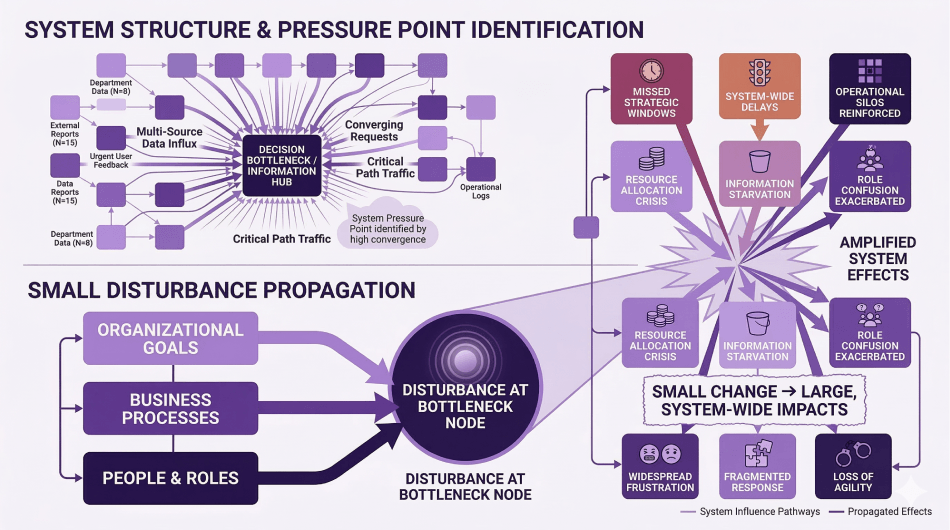
System Pressure Points

Systems Layer

A system pressure point is a location within a system where small structural weaknesses can produce disproportionate effects.

These points typically occur where the system has:

  • high dependency concentration — many components relying on a single element
  • information convergence — critical signals passing through a narrow channel
  • decision bottlenecks — authority concentrated in a single node
  • process sequencing dependencies — multiple steps waiting on a single input

Because many interactions pass through these points, disturbances at these locations propagate across the system.

This creates amplification effects.

A minor disruption at a pressure point can ripple outward, influencing many other parts of the system.

In contrast, disruptions in low-connectivity areas may remain localized and have minimal impact.

Structural Translation

In simple terms, some parts of a system carry more weight than others.

If a small issue happens at the right place, the entire system feels the effect.

For example:

  • if many teams rely on one approval step, delays there affect everyone
  • if a central database feeds multiple reports, a small error spreads widely
  • if coordination flows through one person or channel, interruptions slow the entire system

These locations act like structural pressure points.

They hold together large portions of the system’s activity.

Structural Implication

When pressure points are not recognized, organizations often treat disruptions as isolated mistakes.

They might:

  • fix the immediate problem
  • address the individual involved
  • introduce temporary workarounds

But the structural vulnerability remains.

As long as the system continues to concentrate activity at the same pressure points, small disturbances will continue to create large effects.

Identifying these points allows organizations to redesign systems by distributing load, improving information flow, or reducing dependency concentration.

Leverage Insight

Pressure points reveal where systems are most sensitive.

Small structural adjustments at these locations can produce disproportionately large improvements in system performance.

Systems Language helps identify these points by examining dependency patterns and interaction flows.

Pillar: Systems Language — perception.

Instant Digital Access

Secure download link delivered immediately after purchase

Built for Creators

Systems designed to help you build, not just download.

Global Compatibility

Files and toolkits accessible worldwide, no restrictions