

Call us toll free: +64 226953063

Instant worldwide digital delivery — no waiting

GRASPLR Help & Support

Perception 15: Structural Drift

Many systems do not change through dramatic decisions.

Instead, they change slowly.

A process gains an extra approval step. A reporting requirement is added to solve a specific problem. Teams introduce small workarounds to handle unexpected situations.

Each adjustment appears minor and reasonable at the time.

But months or years later, the system feels noticeably different. Work moves more slowly. Coordination becomes harder. Responsibilities become unclear.

No single moment caused the change. The system simply drifted.
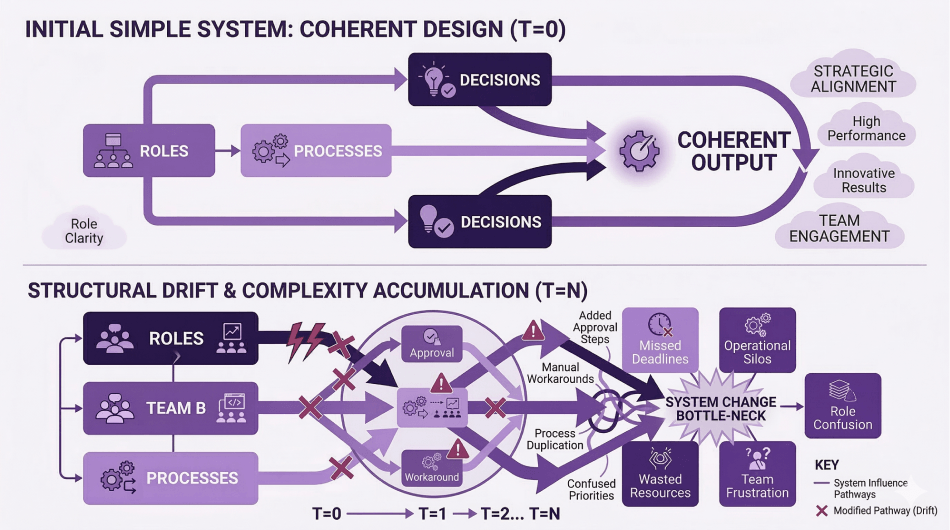
Structural Drift

Systems Layer

Structural drift describes the gradual evolution of a system’s structure through a series of small, local adjustments.

These adjustments typically occur when participants modify the system to solve immediate problems or adapt to changing conditions.

Over time, these changes accumulate and alter the system’s structure.

Structural drift occurs through mechanisms such as:

  • incremental process additions to address specific issues
  • temporary workarounds that become permanent practices
  • local optimizations within individual teams
  • adjustments to constraints or policies made without system-wide redesign

Because these modifications are distributed and incremental, no single participant is responsible for directing the overall structural change.

Yet collectively they reshape the system’s behavior.

The resulting structure may become more complex, less aligned, or differently balanced than the original design.

Structural Translation

In simple terms, systems often change little by little without anyone planning the change.

People make small adjustments to make their work easier or to fix immediate problems.

For example:

  • a new approval is added after a mistake
  • an extra report is required to improve oversight
  • teams create shortcuts to work around delays

Each step solves a local problem.

But over time, these changes accumulate. The system gradually becomes heavier, more complex, or less efficient.

The structure has drifted away from its original form.

Structural Implication

Structural drift can produce unintended system outcomes.

Common results include:

  • processes becoming increasingly complex
  • decision pathways becoming slower or more centralized
  • responsibilities spreading across unclear boundaries
  • coordination costs increasing over time

Because the change occurred gradually, participants may struggle to identify when or why the system became difficult to manage.

Without periodic structural review, drift can slowly degrade system performance.

Leverage Insight

Systems do not remain static.

Small adaptations accumulate and gradually reshape system structure.

Recognizing structural drift allows organizations to periodically step back, reassess system design, and restore alignment before complexity silently overwhelms the system.

Pillar: Systems Language — perception.

Instant Digital Access

Secure download link delivered immediately after purchase

Built for Creators

Systems designed to help you build, not just download.

Global Compatibility

Files and toolkits accessible worldwide, no restrictions