
When a problem appears in an organization, the first response is often to fix the immediate issue.
A missed deadline triggers a review meeting. A breakdown in communication leads to new reporting rules. A project delay results in additional oversight.
These responses address the visible failure.
Yet when the same types of problems continue to appear, it becomes clear that the issue may not be isolated. The system itself may be producing the pattern.
Diagnosing system failures requires looking beyond individual events and examining the structures that generate recurring outcomes.
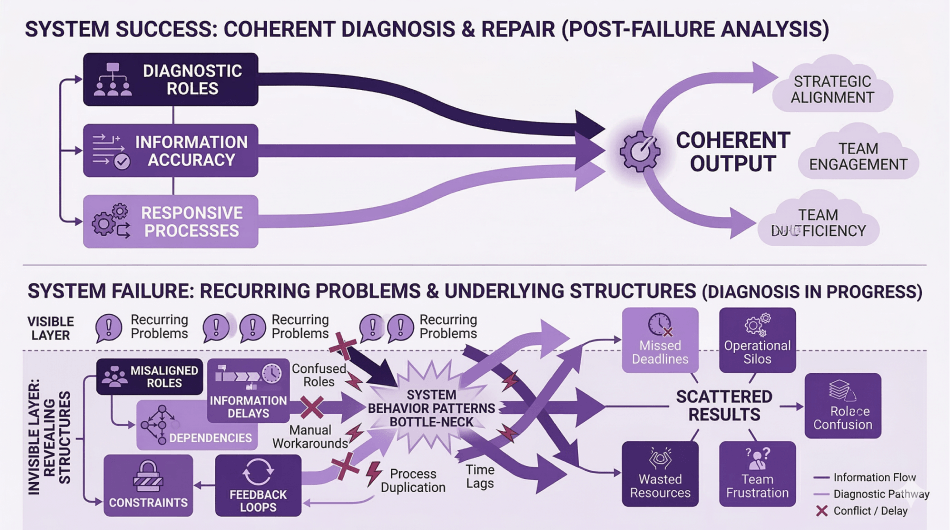
Systems Layer
System failures often appear as repeated patterns of undesirable outcomes.
These patterns typically emerge from underlying structural conditions such as:

- misaligned roles, processes, and goals
- information bottlenecks or delays
- dependency chains that create coordination friction
- feedback loops reinforcing negative behavior patterns
- constraints that unintentionally restrict system performance
Systems Language provides a structured way to investigate these conditions.
Instead of focusing on isolated events, the analysis examines:
- patterns over time — identifying recurring outcomes
- interaction pathways — mapping how components influence one another
- constraints and dependencies — identifying structural limits
- feedback dynamics — observing how system responses reinforce behavior
Through this process, failures are reframed as system behavior generated by structure, rather than as isolated mistakes.
Structural Translation
In simple terms, diagnosing a system failure means asking a different set of questions.
Instead of asking:
“What went wrong this time?”
Systems Language asks:
- What pattern keeps appearing?
- What parts of the system interact to produce this pattern?
- Where are the constraints, delays, or dependencies shaping the outcome?
- What structural conditions make this result likely?
By focusing on these questions, attention shifts from the event itself to the system conditions producing it.
Structural Implication
Without structural diagnosis, organizations often remain trapped in cycles of reactive problem-solving.
Typical patterns include:
- repeatedly fixing symptoms rather than causes
- adding new policies or controls after each failure
- increasing oversight without addressing structural friction
- replacing individuals while leaving system design unchanged
These responses may temporarily reduce the visible problem but do not eliminate the structural conditions that generate it.
As a result, similar failures continue to reappear over time.
Leverage Insight
System failures rarely originate from a single event.
They emerge from patterns created by system structure.
Systems Language provides the analytical tools needed to trace those patterns back to their structural sources — revealing where meaningful system redesign can occur.
Pillar: Systems Language — perception.