

Call us toll free: +64 226953063

Instant worldwide digital delivery — no waiting

GRASPLR Help & Support

Perception 22: Structural Clarity as a Leadership Skill

Leadership decisions often appear to focus on people.

A leader motivates the team, sets priorities, resolves conflicts, and guides strategy. Many leadership discussions therefore emphasize communication style, personality, or individual influence.

These qualities matter. But leaders frequently encounter situations where effort and communication alone do not solve the problem.

Teams remain overloaded despite working harder. Coordination issues persist even after repeated meetings. Initiatives stall even when everyone agrees on the goal.

In these moments, the issue is rarely motivation.

The issue is often structure.
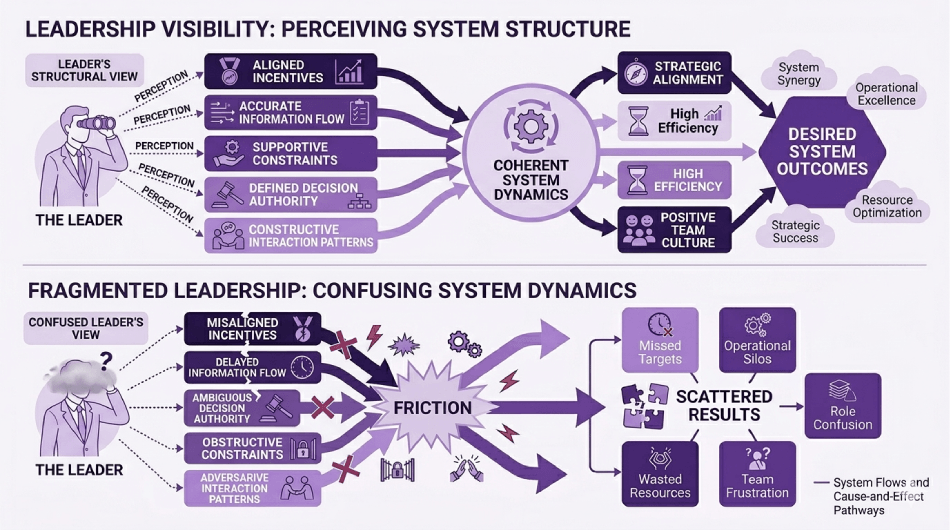
Structural Clarity as a Leadership Skill

Systems Layer

Structural clarity is the ability to perceive and understand the underlying system dynamics shaping outcomes.

Leaders with structural clarity examine systems in terms of:

  • roles and responsibilities — who performs which functions
  • process structures — how work moves through the system
  • information flows — how signals travel between components
  • constraints and decision rights — what actions are permitted or limited
  • feedback loops — how system responses reinforce or stabilize behavior

These structural elements influence how participants interact and what outcomes emerge.

Leaders who understand these dynamics recognize that system behavior is not simply the result of individual actions.

It is the product of structures guiding those actions.

With this awareness, leadership shifts from managing isolated events to shaping the environment in which decisions occur.

Structural Translation

In simple terms, leaders with structural clarity look at how the system is set up, not just what people are doing.

Instead of asking:

“Why is this team struggling?”

They ask:

  • Are responsibilities clearly defined?
  • Do processes support the goal we are trying to achieve?
  • Are decision rights located in the right place?
  • Is information reaching the people who need it?

By examining these structural conditions, leaders can address the causes of recurring problems rather than repeatedly responding to symptoms.

Structural Implication

When leadership lacks structural clarity, decisions often focus only on visible issues.

Common patterns include:

  • encouraging teams to work harder without adjusting system constraints
  • resolving conflicts between individuals without addressing coordination structures
  • introducing new initiatives without aligning roles and processes

These responses may temporarily relieve pressure but do not resolve the structural conditions producing the problem.

Leaders who understand system dynamics can intervene at the level where the system’s behavior is actually generated.

Leverage Insight

Leadership influence is strongest when it operates at the level of system design.

Structural clarity allows leaders to see the arrangements, constraints, and interactions shaping behavior — making it possible to guide outcomes by adjusting the system itself.

Pillar: Systems Language — perception.

Instant Digital Access

Secure download link delivered immediately after purchase

Built for Creators

Systems designed to help you build, not just download.

Global Compatibility

Files and toolkits accessible worldwide, no restrictions