

Imagine learning a new tool at work. The task itself requires some concentration — understanding how it works, remembering the steps, and applying it correctly. That effort is expected.
But now imagine trying to learn that same tool while switching between five chat threads, responding to emails, and following unclear instructions. Suddenly the task feels far more difficult than it should be.
The work itself hasn’t changed. What changed is the type of mental effort required.
Not all cognitive load is the same.
Systems Layer
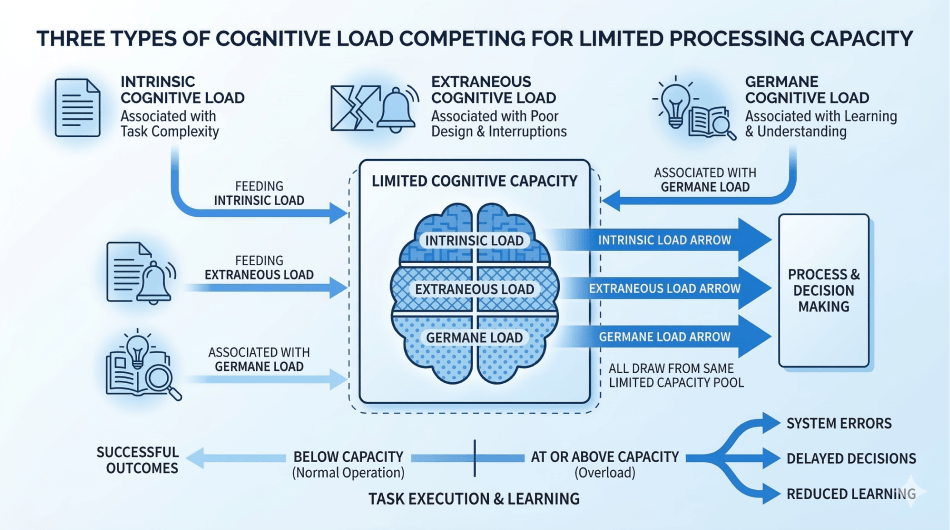
Cognitive load theory identifies three structurally different types of load that compete for the same limited processing capacity.
These are:

- Intrinsic Load
- Extraneous Load
- Germane Load
Each type occupies a portion of the system’s available cognitive capacity, but they arise from different structural sources.
Intrinsic Load
Intrinsic load is generated by the inherent complexity of the task itself. It reflects the number of interacting elements that must be understood simultaneously.
Tasks with many interdependent components produce higher intrinsic load.
Extraneous Load
Extraneous load is generated by the way information, instructions, or tasks are presented. It arises from unnecessary complexity introduced by the environment or system design.
Poor interfaces, unclear instructions, and fragmented workflows increase extraneous load.
Germane Load
Germane load is the cognitive effort directed toward building useful mental models, understanding relationships, and integrating knowledge.
Unlike the other two types, germane load contributes directly to learning and long-term capability.
All three forms draw from the same finite capacity. The balance between them determines overall system performance.
Structural Translation
In simple terms, cognitive load comes from three different sources.
Intrinsic load is the difficulty of the task itself. Some problems simply require more thinking.
Extraneous load is the unnecessary mental work caused by confusing systems, bad instructions, or constant interruptions.
Germane load is the effort your brain spends actually understanding something and building knowledge.
Since your brain has limited capacity, these three types compete with each other.
If too much capacity is wasted on extraneous load, there is less mental space left for the kind of thinking that actually improves performance.
Structural Implication
Many environments unintentionally increase the wrong type of cognitive load.
Organizations often assume that increasing effort will improve results. But if that effort is consumed by extraneous load, the opposite happens.
Examples include:
- navigating poorly structured documentation
- switching between multiple tools to complete one task
- interpreting unclear instructions
- managing excessive notifications
In these environments, people spend large amounts of mental energy simply navigating the system rather than solving the actual problem.
As extraneous load grows, the system leaves less capacity available for germane load — the kind of thinking that builds understanding, skill, and better decisions.
Over time, learning slows and performance stagnates even though people appear busy.
Leverage Insight
Cognitive performance improves not by eliminating effort, but by redistributing cognitive load.
The most effective systems:
- manage intrinsic load
- aggressively reduce extraneous load
- protect capacity for germane load
Within the Cognitive Load pillar, the leverage point is simple:
Performance increases when systems remove unnecessary complexity so cognitive capacity can focus on understanding rather than navigation.

