

Call us toll free: +64 226953063

Instant worldwide digital delivery — no waiting

GRASPLR Help & Support

Capacity 4: Intrinsic Load – The Complexity of the Work Itself

Some tasks feel difficult no matter how organized the environment is.

You can have clear instructions, a quiet workspace, and the right tools, yet the work still requires careful attention. Learning a new programming language, understanding a financial model, or diagnosing a complex system all demand sustained thinking.

The difficulty isn’t caused by distractions or bad tools. It comes from the work itself.

Certain problems simply contain many moving parts that must be understood together.
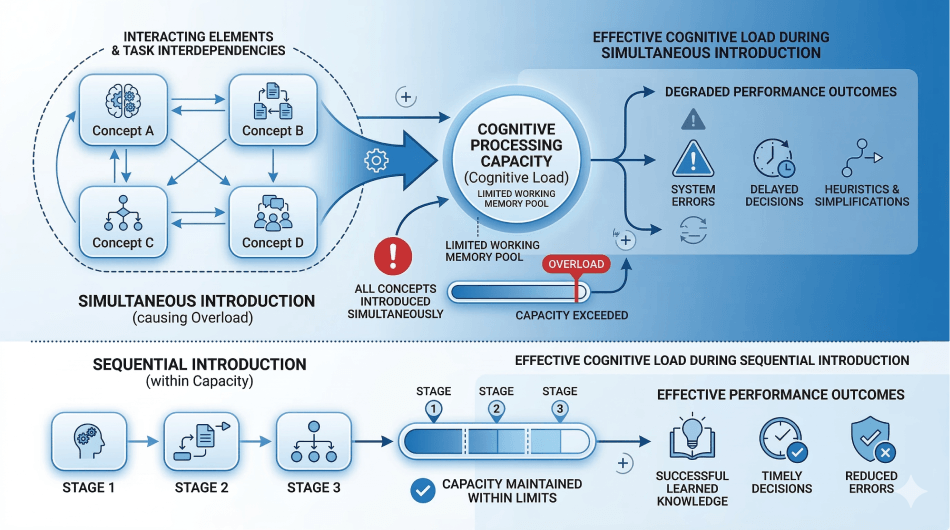
Intrinsic Load: The Complexity of the Work Itself

Systems Layer

Intrinsic load refers to the cognitive demand created by the inherent complexity of a task.

In systems terms, intrinsic load is determined by the number of interacting elements that must be processed simultaneously in order to complete the task correctly.

A task with few independent elements produces low intrinsic load.
A task with many interdependent elements produces high intrinsic load.

For example:

  • remembering a single rule involves low element interaction
  • solving a multi-variable equation requires coordinating multiple elements simultaneously
  • diagnosing a system failure may require understanding several interacting components

Because intrinsic load arises from the structure of the problem itself, it cannot be eliminated without fundamentally changing the task.

What can change, however, is how the work is sequenced and structured over time.

Structural Translation

In simple terms, intrinsic load is the built-in difficulty of the work.

Some tasks require you to hold several ideas in your head at the same time. If those ideas interact with each other, the thinking becomes more demanding.

For example, learning the individual parts of a system is easier than understanding how all the parts work together.

You can’t remove that complexity without removing the problem itself. The only effective way to manage it is to break the work into smaller stages so the brain processes fewer interacting pieces at once.

Structural Implication

When organizations ignore intrinsic load, they often try to simplify work that cannot actually be simplified.

This can appear as:

  • compressing complex training into short sessions
  • presenting too many concepts simultaneously
  • expecting rapid mastery of highly interconnected systems
  • introducing advanced tools before foundational understanding exists

These approaches increase the number of interacting elements a person must process at once.

As intrinsic load exceeds cognitive capacity, comprehension breaks down. People may memorize steps or procedures without understanding how the system works.

The result is fragile knowledge — performance that works under familiar conditions but fails when the situation changes.

Leverage Insight

Intrinsic load cannot be removed, but it can be sequenced.

The leverage point is not simplifying the work itself, but structuring the order in which complexity is introduced.

Within the Cognitive Load pillar, effective systems protect understanding by ensuring that complex tasks are learned progressively rather than all at once.

Capacity is preserved when complexity is revealed step by step.

Instant Digital Access

Secure download link delivered immediately after purchase

Built for Creators

Systems designed to help you build, not just download.

Global Compatibility

Files and toolkits accessible worldwide, no restrictions