

Call us toll free: +64 226953063

Instant worldwide digital delivery — no waiting

GRASPLR Help & Support

Capacity 5: Extraneous Load – The Cost of Poor Design

You try to complete a simple task — submit a report, configure a setting, or follow a procedure. The work itself isn’t particularly difficult. But the process around it feels frustrating.

Instructions are scattered across documents. The interface uses unfamiliar labels. Important information is buried in long messages. You switch between multiple tools just to finish one step.

The task should be straightforward, yet it takes far more effort than expected.

The problem isn’t the task. It’s the system around it.
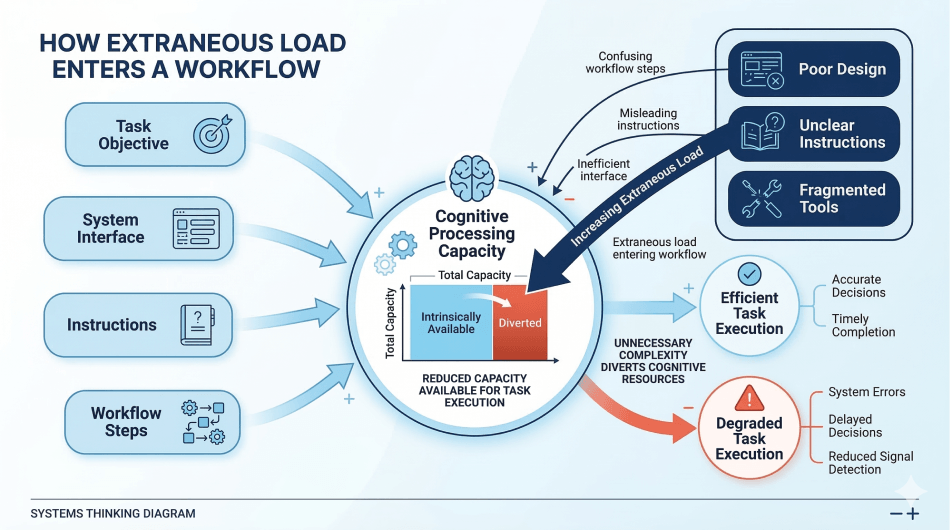
Extraneous Load: The Cost of Poor Design

Systems Layer

Extraneous load is the cognitive demand created by how work is presented, structured, or delivered, rather than by the work itself.

In systems terms, extraneous load emerges when the environment introduces unnecessary processing requirements that do not contribute to solving the core problem.

These additional demands can arise from:

  • poorly organized information structures
  • fragmented workflows across multiple systems
  • unclear instructions or ambiguous signals
  • excessive interruptions or notifications
  • inconsistent terminology or labeling

Each of these factors introduces additional signals that the system must interpret and manage.

Since cognitive processing capacity is finite, extraneous load competes directly with the mental resources required for the actual task.

The system becomes less efficient not because the task is difficult, but because the system surrounding the task requires unnecessary navigation.

Structural Translation

In simple terms, extraneous load is mental effort spent dealing with bad system design.

Instead of focusing on the real work, your brain spends energy figuring out things like:

  • where information is located
  • what instructions actually mean
  • which tool or document to use
  • what step comes next

None of this effort improves the outcome of the task itself. It’s simply the cost of navigating a confusing system.

When too much mental energy goes into this navigation, less capacity remains for thinking, learning, and decision-making.

Structural Implication

Organizations often underestimate the cost of extraneous load because each individual friction point appears small.

A confusing document.
A poorly designed interface.
An extra approval step.
Another communication channel.

Individually, these may seem minor. Structurally, they accumulate.

As extraneous load increases, people spend more time managing the system rather than performing the work. Cognitive capacity becomes fragmented across many small decisions and interruptions.

The result is slower workflows, reduced focus, and higher error rates — even when the underlying tasks are relatively simple.

In extreme cases, the environment becomes so complex that people develop workarounds simply to bypass the system itself.

Leverage Insight

Extraneous load represents one of the most powerful leverage points in cognitive systems because it is entirely structural.

Unlike intrinsic complexity, it can often be removed through better system design.

Within the Cognitive Load pillar, the most effective environments aggressively reduce unnecessary friction so that cognitive capacity can be directed toward solving problems rather than navigating systems.

When extraneous load falls, clarity and performance rise almost immediately.

Instant Digital Access

Secure download link delivered immediately after purchase

Built for Creators

Systems designed to help you build, not just download.

Global Compatibility

Files and toolkits accessible worldwide, no restrictions