

Call us toll free: +64 226953063

Instant worldwide digital delivery — no waiting

GRASPLR Help & Support

Capacity 11: Cognitive Load in Team Environments

A team begins working on a project together. At first, collaboration feels productive. Everyone shares updates, ideas, and questions through meetings, chat channels, and shared documents.

But as the project grows, the volume of communication increases. Messages multiply. More people become involved in each decision. Conversations overlap across multiple platforms.

Soon, team members feel like they are constantly catching up on information rather than making progress.

The work itself hasn’t necessarily become more complex.

What has changed is the structure of how information moves through the team.
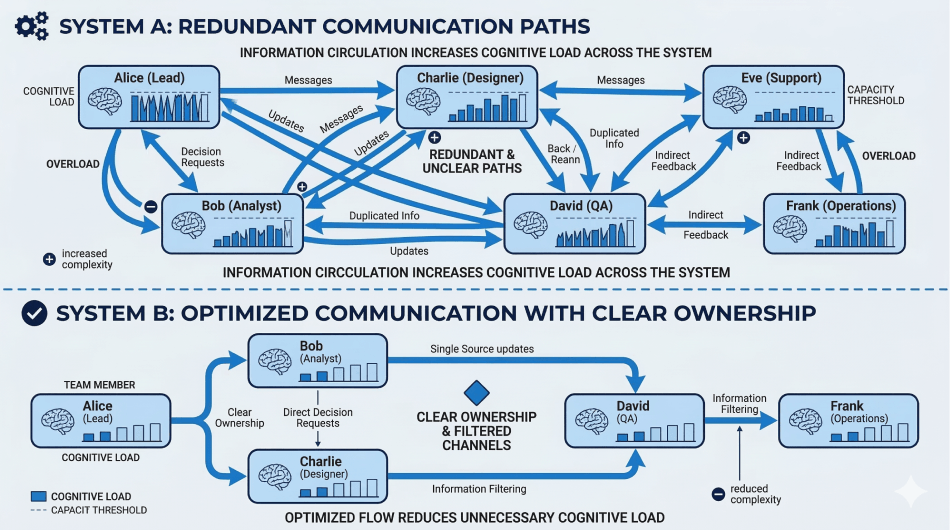
Cognitive Load in Team Environments

Systems Layer

In team environments, cognitive load does not exist only at the individual level. It also emerges from the structure of information flow across the group.

Each team member acts as a processing node within the larger system. Information enters these nodes through communication channels, task assignments, and decision requests.

When responsibilities and information pathways are poorly structured, several dynamics increase collective cognitive load:

  • redundant information flows across multiple nodes
  • unclear ownership causes multiple people to track the same signals
  • communication channels multiply without clear filtering
  • decision authority becomes distributed without coordination

These conditions create signal duplication and diffusion, where the same information must be processed repeatedly across the system.

As more information circulates through the network, cognitive demand spreads across multiple nodes simultaneously.

The result is distributed overload.

Structural Translation

In simple terms, team overload often happens when too much information moves through too many people at once.

If everyone needs to stay informed about everything, each person must process a large amount of information just to understand what is happening.

This creates several problems:

  • people read messages that don’t require their action
  • multiple people try to solve the same problem
  • decisions slow down because ownership is unclear

Instead of reducing workload through collaboration, the team unintentionally increases the mental effort required to operate the system.

Structural Implication

Modern collaboration tools make it easy for information to spread widely across teams.

Group chats, shared dashboards, open documents, and frequent meetings create highly connected communication networks.

While this increases visibility, it also increases cognitive exposure — the number of signals each person must interpret.

As exposure rises, individuals spend more time filtering information and less time performing focused work.

In extreme cases, teams become trapped in continuous communication cycles where information circulates constantly but decisions and progress slow down.

The team appears active, but cognitive capacity is being consumed by coordination rather than execution.

Leverage Insight

Team performance depends not only on individual capability but also on how information and responsibility are structured across the system.

Within the Cognitive Load pillar, effective teams reduce distributed overload by designing clear ownership, filtered information flows, and structured decision pathways.

When information moves through the right nodes rather than through every node, the system preserves cognitive capacity for meaningful work.

Instant Digital Access

Secure download link delivered immediately after purchase

Built for Creators

Systems designed to help you build, not just download.

Global Compatibility

Files and toolkits accessible worldwide, no restrictions