

Many modern work environments celebrate multitasking.
People answer messages during meetings, switch between documents while responding to emails, and manage several projects simultaneously. Being able to juggle multiple tasks at once is often seen as a sign of productivity.
At first glance, it appears efficient. Multiple activities are happening at the same time, and progress seems to be made on several fronts.
But when tasks take longer than expected and mistakes begin to appear, the hidden cost becomes clear.
The appearance of speed often masks a deeper inefficiency.
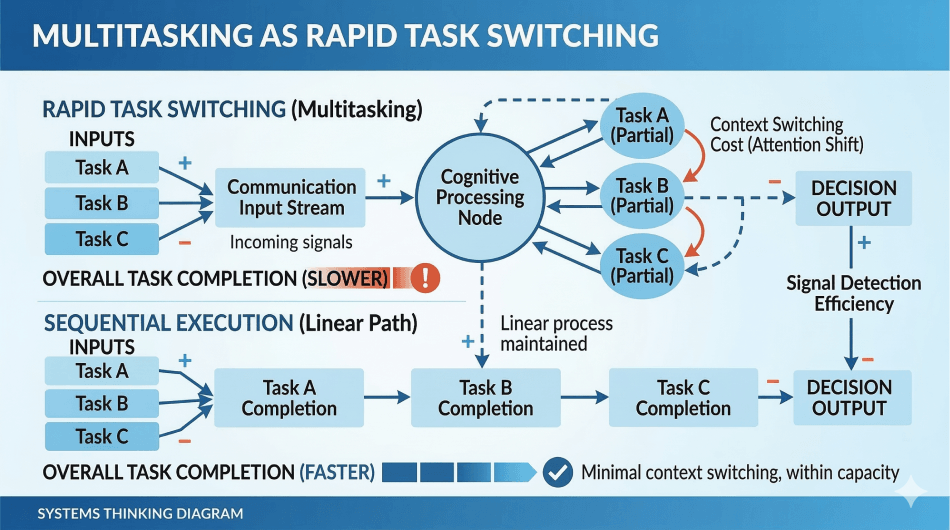
Systems Layer
Human cognition is not designed for true parallel processing of complex tasks.
Instead, the system relies primarily on sequential attention, where cognitive resources are focused on one task at a time within working memory.

Multitasking therefore operates as rapid task switching rather than simultaneous processing.
Each switch between tasks requires the system to:
- deactivate the current cognitive context
- load the structure of the next task
- reconstruct relevant information and goals
This process introduces switching costs, which include lost time, increased cognitive load, and higher error rates.
As the number of active tasks increases, the system must repeatedly rebuild task contexts, consuming additional cognitive resources.
Rather than increasing productivity, multitasking increases the amount of cognitive effort required to perform the same work.
Structural Translation
In simple terms, multitasking usually means switching back and forth between tasks very quickly.
Every time your brain switches tasks, it has to remember what the new task is about and what step comes next. That mental reset takes time and effort.
If you switch tasks frequently, your brain spends a large portion of its energy simply reorienting itself.
Instead of finishing one task efficiently, you end up moving a little bit forward on many tasks while constantly rebuilding your focus.
Structural Implication
Modern work environments unintentionally encourage multitasking.
Communication platforms, project management tools, and continuous notifications create conditions where multiple tasks compete for attention simultaneously.
Professionals may attempt to keep up by distributing their attention across many activities.
Structurally, however, this increases cognitive load and reduces efficiency.
Common outcomes include:
- longer completion times for complex tasks
- fragmented attention across projects
- increased mistakes or overlooked details
- mental fatigue from constant switching
Although the system appears active, much of its processing capacity is spent managing transitions rather than producing meaningful progress.
Leverage Insight
Multitasking creates the illusion of productivity while increasing the cognitive cost of work.
Within the Cognitive Load pillar, effective systems support task continuity and focused execution, allowing cognitive resources to remain aligned with a single objective long enough for meaningful progress to occur.
Efficiency improves when attention stays stable rather than constantly shifting.

