
At the start of the day, your thinking feels clear.
You can focus on a problem, follow an idea through several steps, and make thoughtful decisions. But as the day progresses, attention becomes scattered. Messages accumulate, priorities shift, and new requests appear.
By the afternoon, even simple decisions may feel heavier than they should.
Nothing about your ability has changed. What has changed is how much of your mental capacity has been consumed.
Protecting that capacity is not simply a matter of discipline. It is a matter of system design.
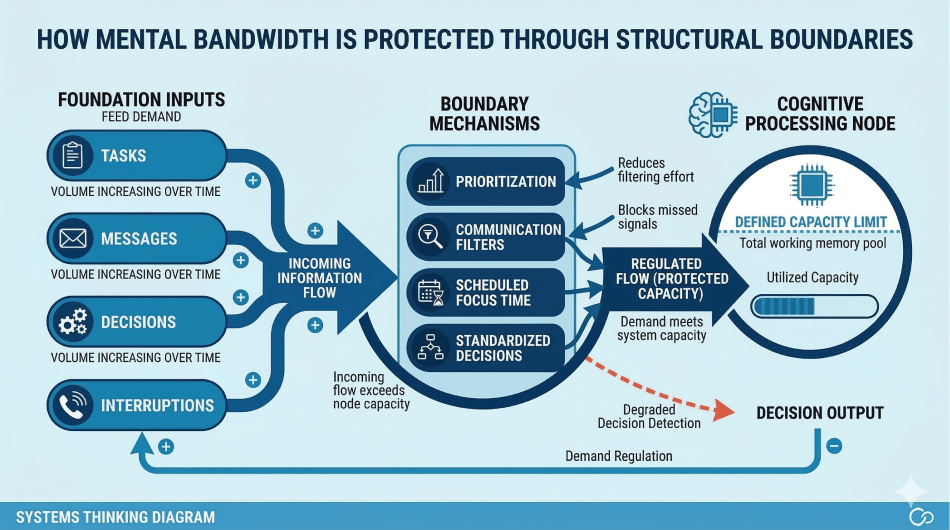
Systems Layer
Cognitive processing operates within a finite bandwidth — the limited capacity available for interpreting signals, holding information in working memory, and making decisions.
This bandwidth is continuously consumed by incoming cognitive demands such as:

- tasks requiring attention
- decisions requiring evaluation
- messages requiring interpretation
- interruptions requiring context shifts
When these demands accumulate without structural boundaries, cognitive bandwidth becomes fragmented across many small processing activities.
As fragmentation increases, the system has less capacity available for sustained reasoning and complex problem-solving.
Protecting cognitive capacity therefore requires structural mechanisms that regulate how and when cognitive demand enters the system.
These mechanisms often take the form of:
- priority structures that limit simultaneous tasks
- communication boundaries that reduce unnecessary signals
- scheduling structures that preserve uninterrupted work periods
- decision frameworks that reduce unnecessary choice
Each mechanism reduces the volume or timing of cognitive demand.
Structural Translation
In simple terms, protecting mental bandwidth means controlling how much complexity reaches your brain at once.
If too many tasks, messages, and decisions arrive together, your cognitive capacity becomes spread across many small demands.
Boundaries help prevent this.
For example:
- clear priorities limit how many tasks compete for attention
- communication rules reduce unnecessary interruptions
- focused work periods allow deeper thinking
- standardized processes remove routine decisions
These structures don’t reduce capability. They simply prevent mental resources from being consumed by avoidable complexity.
Structural Implication
In many environments, cognitive demand is allowed to grow without constraint.
New tools increase communication speed. New processes add reporting requirements. More collaboration introduces additional decision points.
Without boundaries, these signals accumulate.
People respond by attempting to keep up with everything simultaneously, which leads to:
- fragmented attention
- slower decision cycles
- reduced depth of thinking
- rising cognitive fatigue
Over time, the system consumes most of its available bandwidth simply managing incoming signals rather than producing meaningful progress.
Leverage Insight
Cognitive capacity is one of the most valuable resources in any knowledge system.
Within the Cognitive Load pillar, protecting mental bandwidth requires designing structures that limit unnecessary cognitive demand before it reaches the system.
Performance improves when attention is preserved for the signals that truly matter.
Boundaries are not restrictions on productivity — they are mechanisms that protect the system’s ability to think clearly.