

Call us toll free: +64 226953063

Instant worldwide digital delivery — no waiting

GRASPLR Help & Support

Capacity 17: Cognitive Load in Learning and Skill Development

Learning a new skill often feels overwhelming at first.

The terminology is unfamiliar. The steps seem complicated. Each new concept introduces another layer of information to understand.

But when learning is structured well, something interesting happens. What once felt confusing gradually becomes manageable. Concepts start connecting together. Tasks that required careful effort become smoother and more automatic.

The skill itself has not necessarily become simpler.

What changed was how the learning process managed cognitive load.
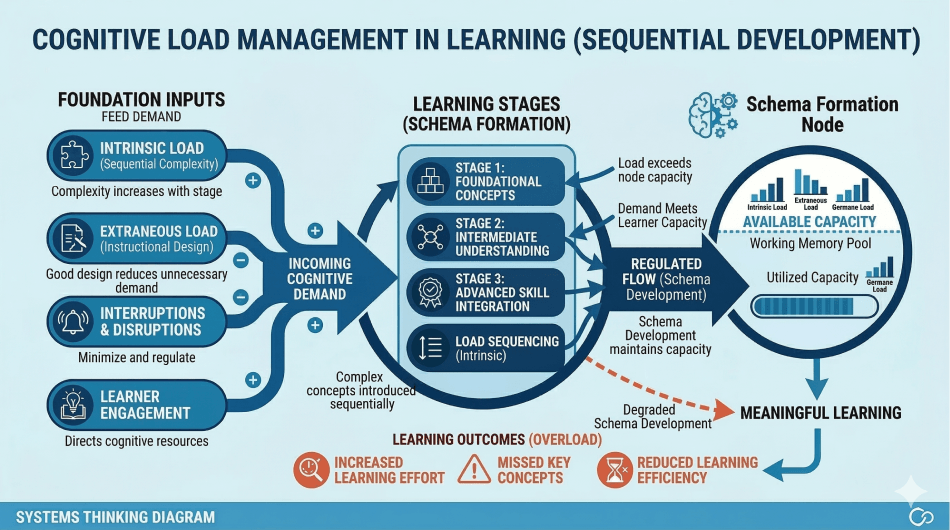
Cognitive Load in Learning and Skill Development

Systems Layer

Learning environments operate as cognitive load management systems.

When individuals encounter a new skill or domain, they must process multiple unfamiliar elements within working memory. If too many elements interact simultaneously, cognitive capacity can be exceeded, preventing meaningful understanding.

Effective learning design therefore manages three interacting factors:

  • Intrinsic load — the inherent complexity of the skill or subject
  • Extraneous load — unnecessary complexity introduced by poor instructional design
  • Germane load — cognitive effort devoted to building mental models and schemas

Well-designed learning sequences control the total cognitive demand by structuring the order in which complexity is introduced.

This is often achieved through mechanisms such as:

  • progressive concept sequencing
  • guided practice before independent performance
  • reducing irrelevant information during early stages
  • gradually increasing task complexity as schemas form

As mental models develop, multiple elements become integrated into single cognitive structures. This reduces working memory demand for future tasks.

Structural Translation

In simple terms, good learning environments introduce complexity gradually.

Instead of presenting everything at once, they break skills into stages. Early stages focus on understanding the basic parts. Later stages introduce how those parts interact.

This approach keeps the mental load within a manageable range.

As learners build mental models, they begin to recognize patterns. Tasks that once required careful thinking become easier because the brain has organized the information into structures it can use efficiently.

Learning progresses not because the material becomes easier, but because the brain becomes better organized to process it.

Structural Implication

When learning environments ignore cognitive load, training often becomes ineffective.

Common examples include:

  • presenting too many concepts in a single session
  • introducing advanced tools before foundational understanding
  • overwhelming learners with large volumes of information
  • providing minimal structure for practice or feedback

In these cases, cognitive capacity is consumed by managing complexity rather than forming mental models.

Learners may memorize isolated steps without understanding the system behind them. Performance may appear functional in familiar situations but breaks down when conditions change.

Without careful sequencing, learning stalls because the system is overloaded before schemas can form.

Leverage Insight

Skill development depends less on the quantity of information delivered and more on how cognitive load is structured across time.

Within the Cognitive Load pillar, effective learning systems introduce complexity progressively so that mental models can form without exceeding processing capacity.

Mastery emerges when complexity is revealed in stages that the cognitive system can absorb.

Instant Digital Access

Secure download link delivered immediately after purchase

Built for Creators

Systems designed to help you build, not just download.

Global Compatibility

Files and toolkits accessible worldwide, no restrictions