
In many teams, certain individuals gradually become the center of everything.
They are the ones people ask for answers. They review the difficult decisions. They solve the complicated problems. Over time, more requests flow toward them because they have proven capable.
At first, this seems efficient. The system directs work toward the most experienced person.
But eventually something changes. The person becomes overloaded, decisions slow down, and the entire system begins to depend on a single point of processing.
What once appeared efficient turns into a structural vulnerability.
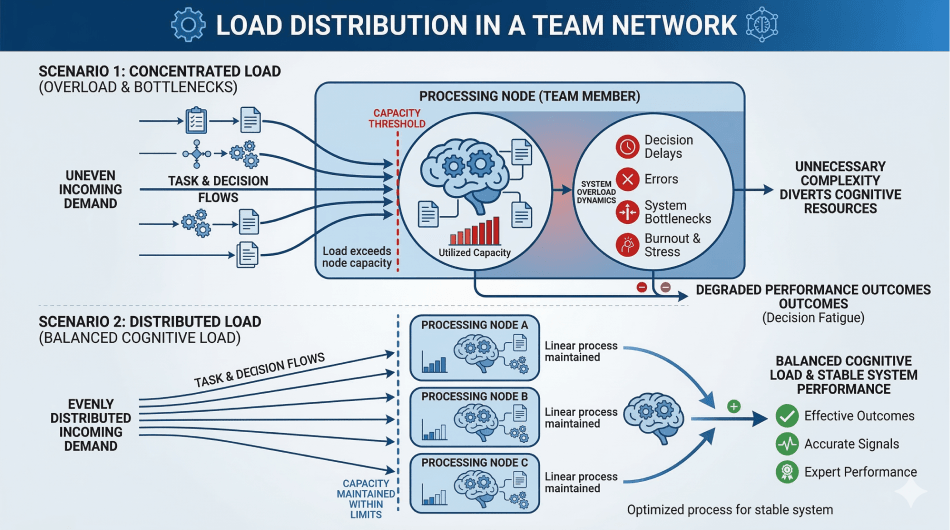
Systems Layer
All complex systems must manage load distribution — the way work, information, and decision demands are spread across available processing nodes.
In human systems, these nodes are individuals or teams capable of interpreting signals and producing outcomes.

When load is unevenly distributed, several structural problems emerge:
- certain nodes receive a disproportionate volume of tasks or decisions
- other nodes remain underutilized or disconnected from key signals
- processing delays accumulate at overloaded nodes
- the system becomes dependent on a small number of individuals
Because each cognitive node has a limited processing capacity, concentrated load eventually exceeds that capacity.
This creates system bottlenecks, where the overall performance of the system becomes constrained by the most overloaded node.
Balanced load distribution allows cognitive demand to be shared across multiple nodes, increasing overall system resilience and throughput.
Structural Translation
In simple terms, systems work better when responsibility and workload are spread across the group rather than concentrated on a few individuals.
If too many tasks, decisions, or questions flow toward one person, that person eventually becomes overwhelmed.
When this happens:
- decisions take longer
- tasks start to pile up
- the rest of the team must wait for responses
Even though the team may have enough total capability, the system slows down because too much work is passing through a single point.
Distributing the load prevents this bottleneck from forming.
Structural Implication
Many organizations unintentionally concentrate load around highly capable individuals.
This happens through patterns such as:
- repeatedly routing difficult decisions to the same expert
- relying on a small number of leaders to approve most actions
- allowing unclear ownership to escalate questions upward
- failing to develop distributed expertise across the team
Over time, the system becomes structurally fragile.
If the overloaded individual becomes unavailable or exhausted, the system struggles to function because critical knowledge and decision capacity are concentrated in one place.
This dynamic increases both individual burnout and systemic risk.
Leverage Insight
Balanced load distribution increases both human sustainability and system resilience.
Within the Cognitive Load pillar, effective systems deliberately distribute tasks, decisions, and information flows across multiple nodes so that no single individual becomes a chronic bottleneck.
When cognitive demand is shared across the network, the system maintains stable performance without exhausting its most capable members.