

Some workflows feel smooth and predictable.
You know where information is located, what the next step should be, and how decisions are made. Work progresses steadily because the process itself provides structure.
Other workflows feel very different. Instructions are scattered. Steps are unclear. People constantly ask each other what should happen next.
In these situations, the work itself may not be difficult, yet it still feels mentally exhausting.
The difference often lies not in the task, but in the structure of the workflow.
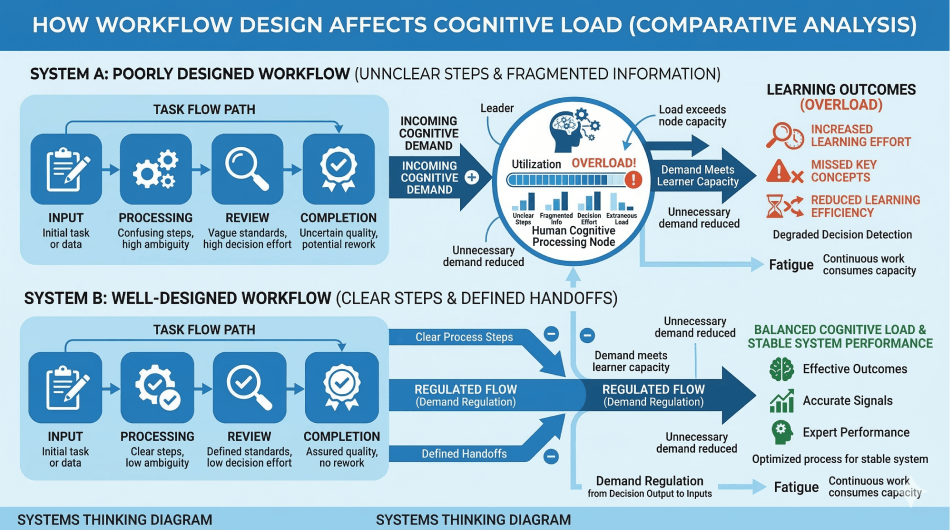
Systems Layer
A workflow functions as a structural pathway for cognitive activity.
It defines how tasks move through a system, how information is transferred between nodes, and how decisions are triggered.

When workflows are poorly structured, individuals must perform additional cognitive operations to maintain progress.
These operations may include:
- determining the next step in the process
- locating required information
- interpreting incomplete instructions
- deciding who is responsible for the next action
Each of these activities consumes cognitive processing capacity without directly advancing the core task.
Well-designed workflows reduce this burden by embedding structural guidance into the process itself.
Clear steps, defined handoffs, and standardized information structures allow cognitive resources to focus on the work rather than on navigating the system.
Structural Translation
In simple terms, a good workflow tells people what to do next without requiring them to constantly figure it out.
When processes are clear, people spend less time asking questions like:
- What step comes next?
- Who should handle this part?
- Where is the information I need?
Instead, the structure of the workflow guides them through the task.
This reduces unnecessary mental effort and makes it easier to focus on solving the actual problem.
Structural Implication
Organizations sometimes prioritize flexibility over structure when designing workflows.
While flexibility can be valuable, excessive ambiguity often increases cognitive load.
Common examples include:
- processes with undefined steps
- unclear ownership of tasks
- information scattered across multiple systems
- inconsistent procedures for similar work
Under these conditions, individuals must reconstruct the workflow repeatedly.
The result is slower execution, more communication overhead, and increased mental fatigue.
The system consumes cognitive capacity simply maintaining coordination.
Leverage Insight
Effective workflows function as cognitive scaffolding.
Within the Cognitive Load pillar, well-designed processes remove unnecessary decision points and provide clear pathways for work to move through the system.
By embedding structure directly into the workflow, organizations free cognitive capacity for analysis, creativity, and problem-solving.
When the process holds the structure, the mind can focus on the work itself.

