
In many environments, when work becomes difficult, the first instinct is to increase effort.
People stay later, push harder, and attempt to process more tasks, messages, and decisions at once. For a short period, this can appear to work. Output increases and problems seem manageable.
But eventually something changes.
Decisions slow down. Mistakes become more common. Important signals get overlooked. Even highly capable people begin to feel mentally saturated.
At this point the issue is no longer effort. The system has encountered a structural limit.
Systems Layer
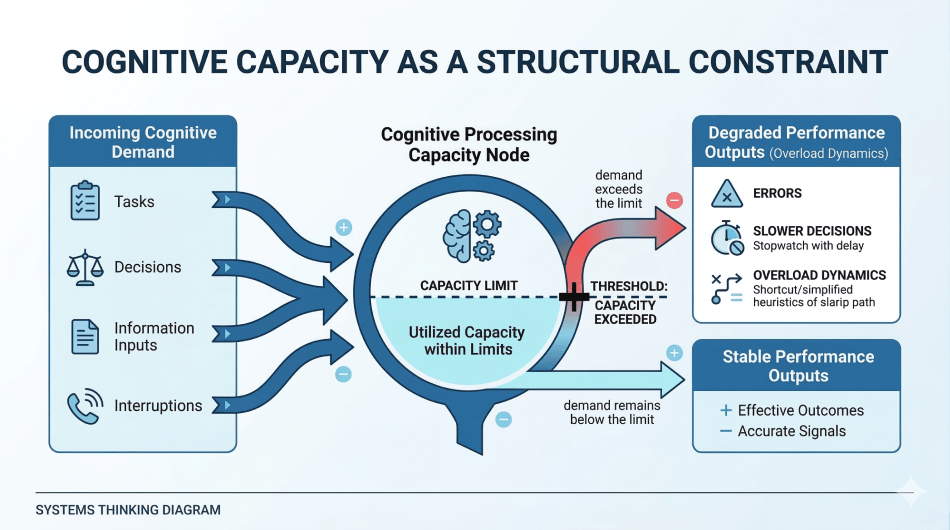
All cognitive systems operate within a finite processing capacity.
This capacity defines the maximum amount of information, decisions, and task complexity that can be processed simultaneously while maintaining stable performance.

Cognitive capacity is constrained by mechanisms such as:
- limited working memory
- finite attention bandwidth
- bounded decision-processing resources
When incoming demand approaches this limit, the system begins to degrade gradually.
This degradation appears through:
- slower processing cycles
- increased error probability
- reduced signal detection
- reliance on simplified decision strategies
If demand continues to exceed capacity, the system cannot stabilize itself and enters persistent overload conditions.
Importantly, this constraint is structural rather than motivational.
No increase in effort can permanently remove the underlying capacity boundary.
Structural Translation
In simple terms, the brain can only handle a certain amount of complexity at one time.
When tasks, decisions, and information exceed that limit, performance starts to decline.
Trying to push harder may work briefly, but it does not expand the system’s capacity.
Instead, the brain becomes slower, more fatigued, and more prone to mistakes.
Just like any system with limited resources, cognitive systems function best when demand stays within their processing limits.
Structural Implication
Many organizations unintentionally design systems that ignore cognitive capacity constraints.
They increase communication channels, add reporting requirements, expand decision layers, and introduce new tools — each of which adds additional cognitive demand.
Individually, these changes may appear beneficial. Structurally, they accumulate.
As complexity grows, people must process more signals, make more decisions, and manage more interactions.
Eventually the system reaches a point where cognitive demand consistently exceeds available capacity.
At this stage, symptoms such as burnout, poor decisions, and operational instability begin to appear.
The system fails not because individuals lack ability, but because the design of the system exceeds human processing limits.
Leverage Insight
Cognitive capacity is one of the most fundamental structural constraints in human systems.
Within the Cognitive Load pillar, effective systems are designed to respect this limit rather than fight against it.
They simplify workflows, filter information, distribute decisions, and remove unnecessary complexity.
When systems align demand with cognitive capacity, clarity improves, decisions stabilize, and performance becomes sustainable.
Respecting capacity is not a limitation of performance.
It is the foundation that allows complex systems to function reliably.