

In many work environments, progress is often measured by effort.
People stay late, attend more meetings, respond to more messages, and handle more tasks. Activity increases, and it feels like progress should follow.
But sometimes the opposite happens. The system becomes busier without becoming more effective.
Meanwhile, a small structural improvement — a rule, a tool, a clarified workflow — can quietly eliminate hours of work across the entire system.
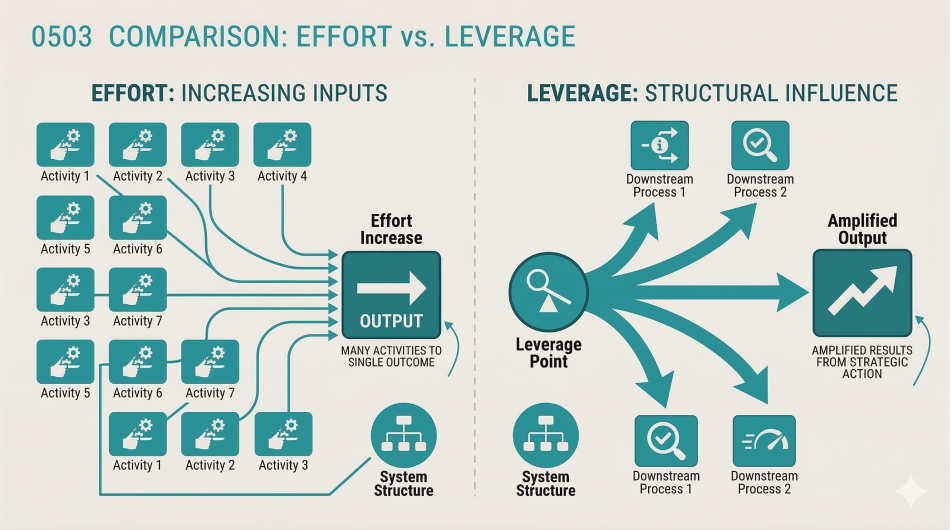
This difference reveals an important distinction: effort increases activity, while leverage multiplies impact.
Systems Layer
In systems terms, effort and leverage operate at different structural levels.
Effort acts within the existing system structure. It increases the amount of activity performed by components inside the system. The structure remains unchanged, so the system behaves largely the same — only with more input.

Leverage, by contrast, modifies the system’s structure.
Structural leverage typically occurs at points such as:
- constraints
- coordination mechanisms
- decision rules
- information channels
- workflow architecture
Because these elements influence many downstream actions, adjusting them changes how the system organizes work.
The result is multiplicative rather than additive impact. One change affects many interactions simultaneously.
Structural Translation
In simple terms, effort means doing more work.
Leverage means changing the system so less work is required.
For example:
- Writing individual explanations repeatedly is effort.
- Creating a reusable template is leverage.
- Manually coordinating tasks is effort.
- Introducing a shared workflow system is leverage.
- Repeatedly resolving the same decision is effort.
- Establishing a clear rule is leverage.
The work required to create leverage is often small compared to the work it replaces.
Structural Implication
When systems rely primarily on effort, activity increases over time.
Teams respond to friction by adding:
- more communication
- more oversight
- more manual coordination
- more task switching
These additions raise cognitive load and slow the system.
Because the underlying structure has not changed, the same problems continue to appear.
Effort accumulates while efficiency remains limited.
Without leverage, the system grows heavier rather than more capable.
Leverage Insight
Effort expands activity.
Leverage reshapes the system so that activity produces more output.
The goal of AtomIQ is not to maximize effort, but to identify the structural points where a small intervention multiplies impact.

