
Sometimes a very small adjustment changes how an entire system behaves.
A simple rule removes constant confusion. A shared template eliminates repeated explanations. A small automation quietly replaces hours of manual work.
These changes often appear insignificant at first. They do not involve large projects, major investments, or dramatic reorganizations.
Yet once introduced, the system begins to move differently.
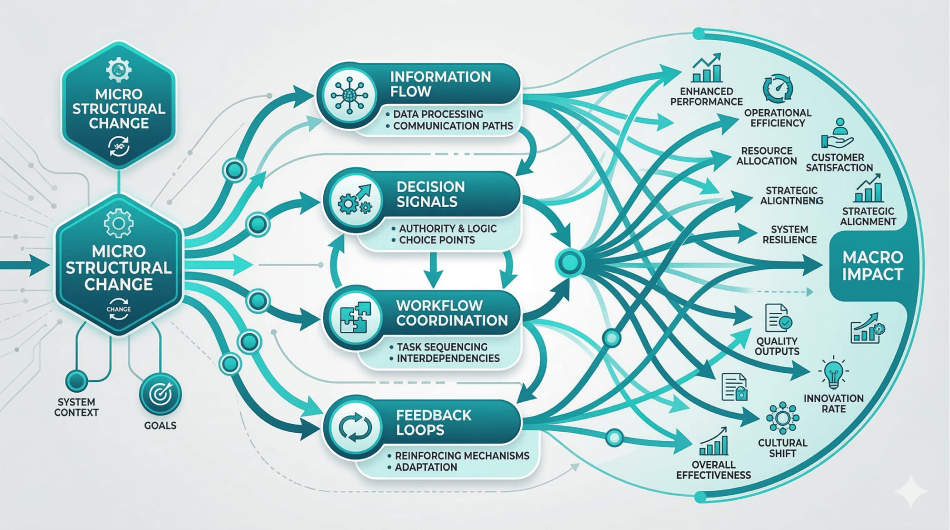
Systems Layer
Complex systems are shaped by structural relationships rather than by isolated actions.
Key structural elements include:

- constraints that limit behavior
- signals that guide decisions
- coordination points between components
- information channels that distribute knowledge
- repeatable workflows that organize activity
Because these structures influence how components interact, even small modifications can redirect system behavior.
A micro-adjustment applied at a structural node alters the signals or constraints that guide activity. Once these signals change, the behavior of many components adjusts accordingly.
The resulting effect spreads through the system, producing a macro-level outcome from a micro-level intervention.
Structural Translation
In simple terms, small structural adjustments can change how many parts of a system behave at once.
For example:
- A naming convention may make files instantly searchable.
- A shared checklist may standardize how tasks are performed.
- A single automation may remove repetitive work from multiple workflows.
- A clear decision rule may eliminate recurring discussions.
Each adjustment is small on its own, but because it influences repeated activity, the effect multiplies across the system.
Structural Implication
When systems overlook structural micro-moves, improvement efforts tend to focus on large initiatives.
Organizations may launch major projects, redesign entire processes, or introduce new programs.
While these efforts can produce change, they often require significant time, coordination, and cognitive load.
Meanwhile, smaller structural adjustments remain unnoticed, even though they may remove friction across many daily activities.
Without attention to micro-level structure, systems may miss opportunities for high-leverage improvement.
Leverage Insight
Large outcomes in complex systems often originate from small structural changes.
AtomIQ focuses on identifying these micro-moves — the precise adjustments that shift behavior across the entire system.