

Decision-making becomes difficult when too many factors compete for attention.
A team may review dozens of variables before making a choice: risks, timelines, preferences, dependencies, resource availability, and potential outcomes. The discussion expands, the analysis grows heavier, and clarity becomes harder to reach.
Yet in many situations, a few key variables ultimately determine the outcome.
When those variables are identified early, decisions that once felt complex often become much simpler.
Systems Layer
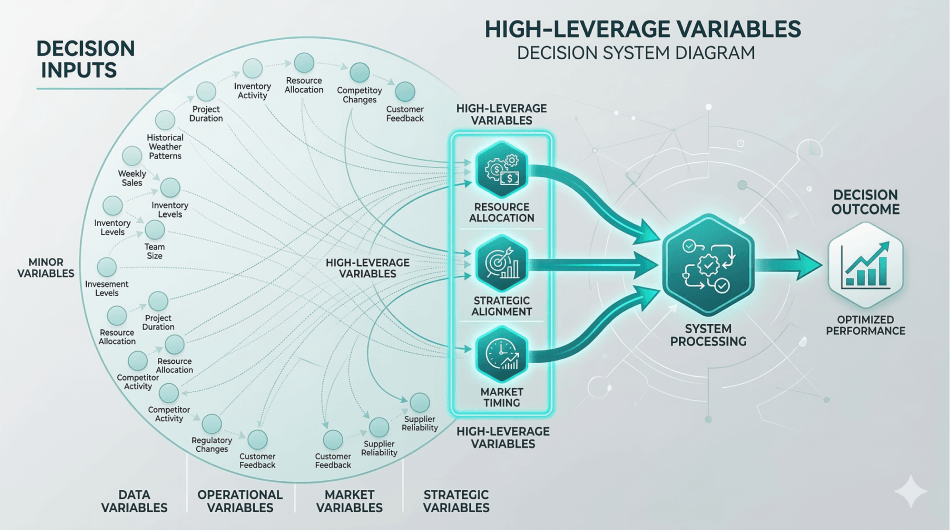
In complex systems, outcomes rarely depend equally on all variables.
Instead, system behavior is typically influenced by a small number of structurally dominant variables. These variables sit at influential points within the system’s constraints, information flows, and feedback mechanisms.

Because they shape how other components respond, these variables have disproportionate impact.
From a systems perspective, decision complexity increases when attention is distributed across many low-influence variables.
Leverage emerges when decision-makers identify and focus on the variables that most strongly influence system behavior.
By isolating these high-influence variables, the decision process shifts from evaluating many possibilities to evaluating a few structurally meaningful conditions.
Structural Translation
In simple terms, not every factor matters equally when making a decision.
Some variables shape what is realistically possible, while others only affect minor details.
For example:
- In a project decision, the key variable might be resource capacity rather than individual task preferences.
- In a workflow decision, the constraint might be information availability rather than team coordination.
- In a product decision, user behavior may matter more than internal assumptions.
When the most influential variables are identified, the decision becomes clearer because many other considerations naturally fall into place.
Structural Implication
Without identifying leverage variables, decision-making systems tend to expand in complexity.
Teams may:
- analyze excessive data
- debate low-impact details
- delay decisions while gathering more information
- revisit the same discussions repeatedly
This increases cognitive load while providing limited clarity.
The decision system becomes slower and more exhausting, even though the outcome may ultimately depend on only a few core factors.
Leverage Insight
Effective decision-making focuses attention on the variables that shape system behavior.
AtomIQ in decision systems means identifying the small number of influential factors that determine the direction of the entire decision.

