
Some inefficiencies are easy to notice.
A broken process, a missing tool, or a major delay quickly attracts attention. These issues often trigger improvement efforts.
But many systems are slowed by something less visible: small, repeated obstacles that seem too minor to address individually.
Searching for information. Reconfirming decisions. Switching between tools. Repeating explanations.
Each instance may only take a moment. Yet across a day, a week, or an entire organization, these small frictions accumulate into significant inefficiency.
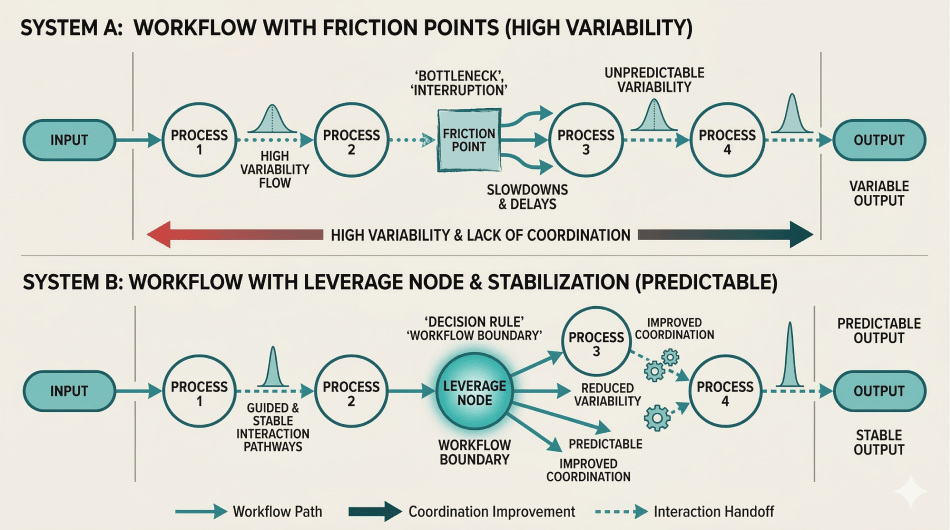
Systems Layer
In system environments, friction appears as small structural resistances that interrupt the normal flow of activity.
These resistances often occur at points where components interact, such as:

- information retrieval
- workflow handoffs
- decision confirmation
- tool switching
- communication clarification
While each instance may appear insignificant, these interactions are often repeated many times throughout the system.
Because the friction occurs at frequently used interaction points, it multiplies across many participants and activities.
A small structural adjustment that removes friction at one of these nodes can therefore reduce effort across the entire system.
This creates leverage: a minimal intervention producing a large cumulative effect.
Structural Translation
In simple terms, systems slow down when people constantly encounter small obstacles.
Examples include:
- searching through messages to find information
- asking who is responsible for a task
- copying data between systems
- confirming details that should already be clear
Each interruption requires attention and time.
If these obstacles occur repeatedly, they quietly consume large amounts of energy.
Removing even one of these frictions — such as by centralizing information, clarifying responsibility, or automating a step — can noticeably improve efficiency.
Structural Implication
When friction remains embedded in the system, organizations often respond by increasing effort.
People compensate by working faster, multitasking more, or extending working hours.
However, this approach does not remove the structural obstacles.
As activity increases, the friction points continue to generate delays and interruptions.
Over time, cognitive load rises and productivity plateaus.
Without addressing structural friction, systems become increasingly effort-intensive.
Leverage Insight
Efficiency often improves not by adding new activity, but by removing the small obstacles that repeatedly interrupt system flow.
AtomIQ focuses on identifying these friction points and eliminating them where a small change can produce system-wide gains.