

Call us toll free: +64 226953063

Instant worldwide digital delivery — no waiting

GRASPLR Help & Support

Leverage 15: Micro-Adjustments in Workflow Design

Workflows often evolve gradually.

Tasks are added over time, responsibilities shift, and new tools appear. Each change may seem small, but eventually the workflow becomes heavier than necessary.

People may find themselves repeating steps, switching between systems, or waiting for information that should already be available.

In many cases, productivity does not improve through major redesigns but through small adjustments that remove inefficiencies from the workflow itself.
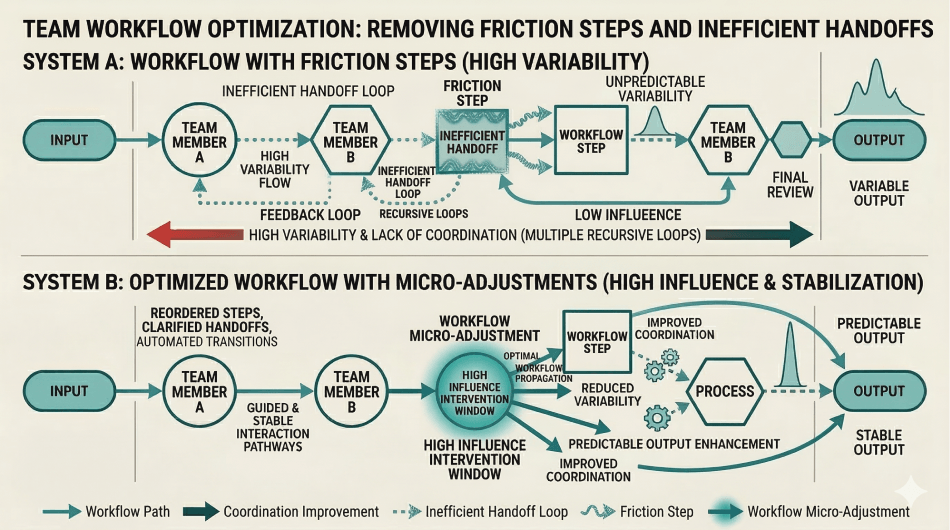
Micro-Adjustments in Workflow Design

Systems Layer

A workflow is a structural sequence that organizes how tasks move through a system.

It includes elements such as:

  • task sequencing
  • handoff points between roles
  • information availability at each step
  • decision checkpoints
  • supporting tools or systems

Because workflows coordinate repeated activity, even small inefficiencies can multiply over time.

For example:

  • unnecessary task duplication
  • poorly timed information delivery
  • unclear handoffs between roles
  • steps that require switching between tools

These inefficiencies introduce friction at points where the system repeatedly operates.

Micro-adjustments that refine these structural points can significantly improve the system’s overall productivity.

Examples include:

  • reordering steps so information arrives when needed
  • consolidating repeated actions into a single step
  • clarifying handoff conditions between roles
  • automating transitions between workflow stages

Each adjustment may appear small, but because it affects repeated activity, the cumulative impact can be substantial.

Structural Translation

In simple terms, workflows become inefficient when small steps are slightly misaligned.

For example:

  • if information arrives too late, people pause the workflow
  • if responsibilities are unclear, work waits for confirmation
  • if tasks require switching between tools, time is lost during transitions

A small change — such as moving a step earlier, clarifying the handoff rule, or integrating tools — can remove delays across the entire process.

Because the workflow repeats frequently, the improvement multiplies over time.

Structural Implication

When workflow structures remain unexamined, organizations often attempt to increase productivity through effort.

Teams may work faster, extend working hours, or add more coordination.

However, these responses do not address the structure that organizes the work.

As a result, the same delays and inefficiencies continue to appear in each cycle of the workflow.

Without structural adjustment, productivity gains remain limited.

Leverage Insight

Workflow productivity often depends on small structural alignments.

AtomIQ focuses on identifying the micro-adjustments that remove friction from repeated processes and allow the system to operate more efficiently.

Instant Digital Access

Secure download link delivered immediately after purchase

Built for Creators

Systems designed to help you build, not just download.

Global Compatibility

Files and toolkits accessible worldwide, no restrictions